


If you have ever asked what is kinesiology in golf coaching, the short answer is that it is the science of human movement applied directly to your swing mechanics. In particular, it studies how your joints, muscles, and nervous system coordinate to produce power, accuracy, and consistency. As a result, coaches who understand kinesiology can diagnose swing faults at their true source instead of guessing from ball flight alone.
Quick answer: Kinesiology in golf coaching is the study of movement, muscle function, and biomechanics (the mechanics of living bodies) applied to the golf swing. Coaches use it to pinpoint inefficient or risky movement patterns and replace them with safer, more powerful mechanics backed by measurable data rather than opinion.
What Is Kinesiology in Golf Coaching?
Kinesiology in golf coaching is the applied science of how the body moves, specifically how muscles, joints, and the nervous system work together through the swing. Rather than relying purely on visual feedback, a kinesiology-trained coach examines the biomechanics of each segment, from ground contact through the follow-through. Consequently, swing changes become evidence-based rather than anecdotal.
Kinesiology, as a broader field, is formally defined as the scientific study of human movement, according to Wikipedia’s overview of the discipline. In golf specifically, that means studying hip rotation, spine angle, weight transfer, and the timing of the kinetic chain, which is the sequence of body segments transferring energy from the ground into the club. Therefore, a kinesiology-based coach is essentially a movement specialist who happens to teach golf.

Understanding what is kinesiology in golf coaching starts with analyzing movement, not just ball flight.
The Science of Movement Behind a Winning Golf Swing
Every effective golf swing relies on a sequence often called the kinetic chain, where energy moves from the ground up through the legs, hips, torso, arms, and finally the clubhead. Specifically, this chain works best when each segment fires in the correct order and at the correct moment. If one link fires too early or too late, power leaks out and compensations develop elsewhere in the body.
For example, a golfer with limited hip rotation may compensate by over-rotating the lower back, which increases strain over time. In fact, research on rotational sports movement patterns, including studies catalogued through the National Library of Medicine’s PubMed database, has linked restricted hip mobility to increased lumbar spine stress during rotational swings. As a result, identifying this limitation early can prevent long-term injury while simultaneously unlocking more clubhead speed.
Furthermore, golf biomechanics coaching does not stop at diagnosing problems. It also measures outcomes. Coaches trained in movement science often track swing speed, sequencing timing, and ground reaction force to confirm that changes are actually working, rather than assuming improvement based on how a swing feels.
Why Ground Reaction Force Matters
Ground reaction force refers to the pressure your feet generate against the ground, which the body converts into rotational power. Notably, elite players on tour generate significantly more ground force than recreational golfers, which partly explains the gap in swing speed. Average PGA Tour driver swing speeds sit around 113 mph, a benchmark frequently referenced by swing-speed tracking systems, compared to roughly 93 to 95 mph for the average male amateur.
How Kinesiology-Based Coaching Works in Practice
In practice, kinesiology-informed coaching blends movement screening with detailed video analysis. Unlike a typical lesson that might only address grip or alignment, this approach starts by assessing how well your body physically moves before ever discussing swing technique. Consequently, the coaching plan is built around your actual physical capabilities rather than a generic swing model.
This is exactly the model used in online golf biomechanics instruction, where remote video review replaces the need for an in-person facility. Because sessions happen digitally, competitive amateurs, collegiate players, and aspiring professionals can access elite-level analysis regardless of where they live.
Step-by-Step: A Kinesiology-Based Swing Analysis
Below is the typical process a kinesiology-trained coach follows when assessing and correcting a golf swing:
- Movement and mobility screening: The coach evaluates joint mobility, posture, and stability in the hips, spine, and shoulders to understand physical limitations before any swing is analyzed.
- Multi-angle swing capture: The golfer records swings from face-on and down-the-line camera angles so the coach can study the full kinetic chain across multiple planes of motion.
- Biomechanical breakdown of sequencing: The coach reviews how force transfers from the ground through the hips, torso, arms, and clubhead to identify timing or sequencing breakdowns.
- Identify compensations and injury risk: Faulty movement patterns that could limit power or create injury risk, such as early extension or restricted hip rotation, are flagged for correction.
- Prescribe targeted drills: The coach builds a customized drill plan grounded in kinesiology principles to retrain movement patterns gradually and safely over several weeks.

Ground reaction force and weight transfer are core concepts in kinesiology-based swing coaching.
Why Sports Science Coaching Matters for Competitive Golfers
Competitive golfers face a different set of demands than casual players. Specifically, they need swings that hold up under tournament pressure, repeat consistently across 18 holes, and avoid the overuse injuries common in a sport involving thousands of repetitive swings per year. This is precisely where sports science coaching, grounded in kinesiology, provides an advantage over generic instruction.
According to data referenced by sports medicine researchers, golf-related injuries frequently involve the lower back, wrist, and shoulder, often linked to compensatory movement patterns rather than a single traumatic event. Therefore, addressing the root biomechanical cause is more effective long-term than simply resting and returning to the same faulty pattern. Programs built around kinesiology in golf instruction are designed specifically to interrupt that cycle.
In addition, collegiate and aspiring professional players often need more technical depth than a typical local instructor can offer. A coach who combines elite playing credentials with formal movement science training, such as an LPGA Master Professional holding a PhD in kinesiology, bridges that gap between practical coaching experience and academic rigor.
Kinesiology-Based Coaching vs Traditional Golf Instruction
Traditional golf instruction often centers on visible outcomes, such as ball flight, clubface angle at impact, or swing path. While useful, this approach can miss the underlying physical cause of a flaw. In contrast, kinesiology-based coaching asks why a compensation exists in the first place, often tracing a slice or inconsistent strike back to limited mobility or poor sequencing rather than a simple technical tip.
As a result, kinesiology-based correction tends to be more durable. Instead of layering a quick fix on top of a mechanical limitation, the coach addresses the limitation itself. This is particularly valuable for golfers recovering from injury or those who have plateaued despite years of conventional lessons. For a deeper breakdown of this comparison, see this complete guide to science-based golf swing analysis.
Choosing a Kinesiology-Informed Golf Coach
When evaluating a coach, it helps to look beyond playing credentials alone. Specifically, ask whether the coach has formal training in movement science, how they assess physical limitations before teaching technique, and whether they track measurable outcomes such as swing speed or sequencing timing. Above all, the coach should be able to explain the biomechanical reasoning behind every drill they prescribe.
Platforms built specifically around this model, such as yourgolfguru.com, pair LPGA Master Professional-level coaching with a PhD in kinesiology to deliver remote, data-driven instruction. This removes the geographic barrier that often limits serious golfers to whatever instructor happens to be nearby. You can also review what distinguishes this coaching platform before committing to a program, or explore coaching designed specifically for competitive golfers seeking measurable swing gains.
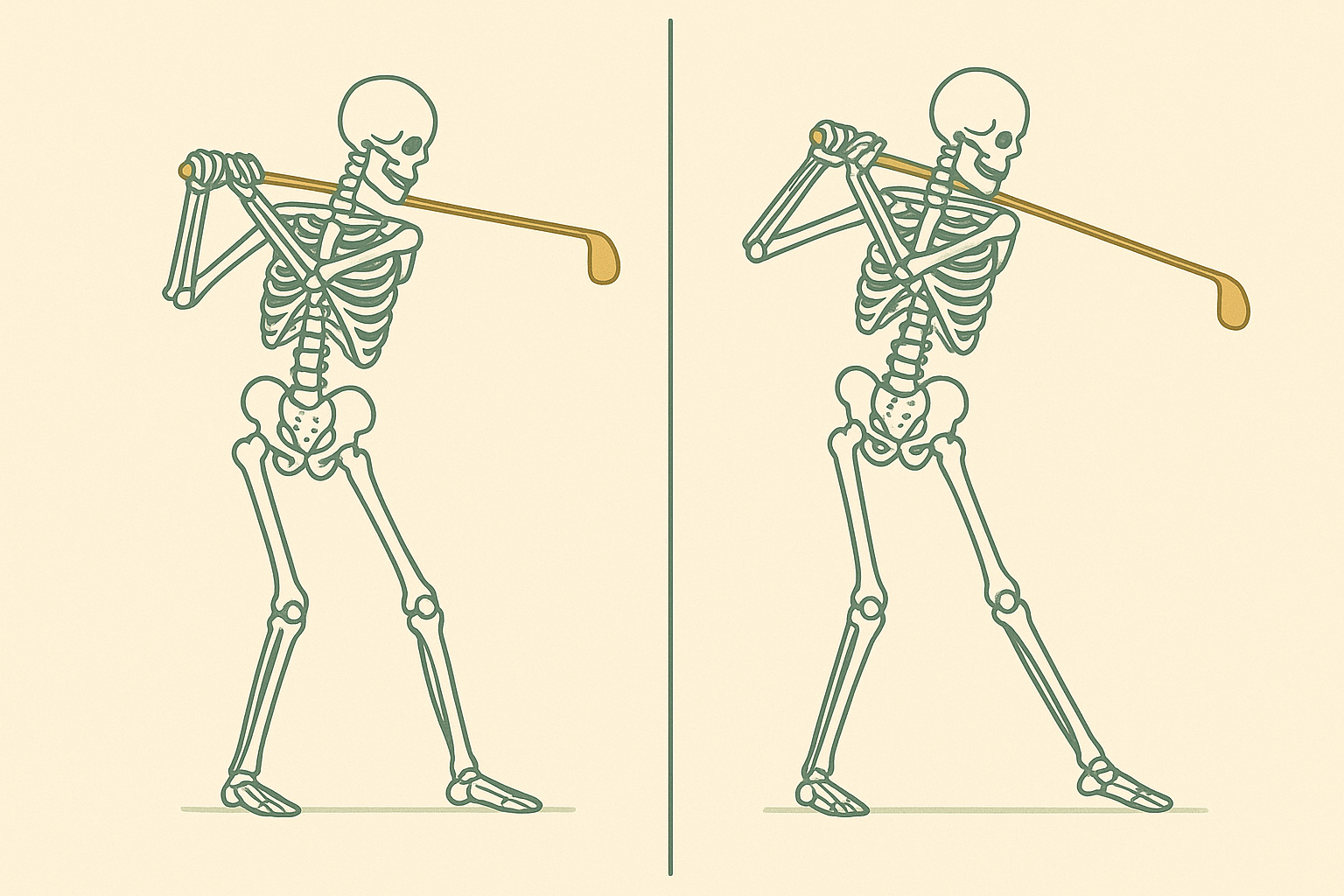
A simplified view of the kinetic chain sequencing central to kinesiology-based golf coaching.
Frequently Asked Questions
What is kinesiology in golf coaching?
Kinesiology in golf coaching is the application of movement science to study how your joints, muscles, and kinetic chain work together during the swing. Coaches use it to improve power, accuracy, and safety rather than relying on feel alone.
How is kinesiology different from a normal golf lesson?
A standard lesson often focuses on ball flight and visual cues, while kinesiology-based coaching analyzes the underlying movement patterns causing those results. This allows a coach to correct the root mechanical issue instead of just the symptom.
Do I need special equipment for kinesiology-based swing analysis?
Most remote kinesiology coaching only requires a smartphone camera and a stable surface to record your swing from face-on and down-the-line angles. Advanced sessions may incorporate mobility screens or launch monitor data when available.
Can kinesiology coaching help prevent golf injuries?
Yes, because it identifies compensations in the kinetic chain before they create repetitive strain. Many lower back, wrist, and shoulder injuries in golf stem from faulty sequencing that kinesiology-based screening can catch early.
How much does kinesiology-based golf coaching typically cost?
Pricing varies widely, but remote biomechanics-based coaching programs often range from $150 to $500 per month depending on session frequency and analysis depth. This is generally comparable to or less than in-person elite instruction.
How long does it take to see results from kinesiology-based coaching?
Many golfers notice improved sequencing and reduced tension within four to six weeks of consistent drill work. However, deeper mechanical changes, such as kinetic chain timing, often take two to three months to fully stabilize under pressure.
Is kinesiology-based coaching only for professional golfers?
No, it benefits any serious player, including competitive amateurs, collegiate athletes, and aspiring professionals. The core value lies in understanding your own movement patterns, which matters regardless of current skill level.
What common mistakes happen without kinesiology-based swing analysis?
Without it, golfers and coaches often chase surface-level symptoms, such as a slice, without addressing the hip or shoulder sequencing causing it. This leads to temporary fixes that break down under tournament pressure.
Can online coaching really apply kinesiology principles effectively?
Yes, remote video analysis combined with structured movement screening can accurately map kinetic chain issues. Many elite coaches now deliver kinesiology-based feedback entirely online using synchronized video review tools.
What credentials should a kinesiology-focused golf coach have?
Look for a coach with formal movement science training, such as a kinesiology degree, alongside recognized teaching credentials like LPGA or PGA certification. This combination ensures both scientific accuracy and practical coaching experience.
Does kinesiology-based coaching work for players recovering from injury?
It is particularly valuable here because it identifies compensation patterns that develop after injury and could cause re-injury if left uncorrected. A kinesiology-trained coach can rebuild swing mechanics around safe, sustainable movement.
How does kinesiology improve swing power specifically?
Kinesiology examines how ground reaction force transfers through the hips, torso, and arms in sequence, known as the kinetic chain. Optimizing this sequence, rather than simply swinging harder, is what generates lasting clubhead speed.
Final Takeaway
In summary, what is kinesiology in golf coaching comes down to one core idea: using the science of human movement to build a swing that is powerful, repeatable, and safe over the long term. Rather than guessing at fixes, a kinesiology-trained coach screens your mobility, analyzes your kinetic chain, and prescribes drills grounded in measurable biomechanics. For competitive amateurs, collegiate players, and aspiring professionals, this approach often closes the gap that generic local instruction cannot. Ultimately, pairing elite coaching credentials with kinesiology expertise, delivered remotely through platforms like yourgolfguru.com, gives serious golfers access to the kind of data-driven, injury-aware instruction once reserved for tour-level athletes.