


Swing secrets for pro golfers are not mystical tricks — they are measurable biomechanical patterns that hold up under pressure, round after round. While weekend players chase quick fixes, tour-level athletes train specific joint sequences, weight transfers, and timing patterns that most local instructors rarely address in depth. This article breaks down the science-backed techniques that elite, kinesiology-trained coaches use to help competitive golfers add power without sacrificing safety. You will also find a step-by-step framework you can apply to your own practice sessions, whether you’re a collegiate player or an aspiring professional.
What Are Swing Secrets for Pro Golfers?
Swing secrets for pro golfers are specific, evidence-based mechanics — including ground force sequencing, hip-shoulder separation, and consistent tempo — that professional-level coaches teach to maximize clubhead speed and accuracy while minimizing injury risk. These techniques rely on kinesiology, the scientific study of human movement, rather than guesswork.
In other words, what looks like natural talent on television is usually the product of thousands of measured repetitions. Furthermore, because these principles are rooted in physics and anatomy, they translate across different body types, ages, and skill levels rather than working for only a handful of naturally gifted athletes.

Motion analysis is one of the tools coaches use to uncover swing secrets for pro golfers hidden within milliseconds of the downswing.
The Science Behind Elite Swing Mechanics
Elite swing mechanics begin at the ground. As a golfer initiates the downswing, force travels from the feet through the hips, torso, arms, and finally the club — a sequence often called the kinematic chain. Consequently, any breakdown early in this chain reduces speed and accuracy no matter how fast the arms move later.
According to biomechanics research summarized by governing bodies such as the United States Golf Association, elite players generate substantially higher ground reaction forces than amateurs, often producing peak forces well above their own body weight during the transition into impact. This extra force, when sequenced correctly, is a major reason pro golfers hit the ball noticeably farther without visibly swinging harder.
In addition, hip-shoulder separation — the degree to which the hips rotate ahead of the shoulders — creates elastic energy that whips the club through impact. Therefore, coaches who understand the golf swing as a biomechanical chain, rather than a static position, can pinpoint exactly where power is lost.
Top Swing Secrets for Pro Golfers Backed by Biomechanics
The following principles show up repeatedly across tour-level swings, regardless of individual style. Specifically, coaches at yourgolfguru.com, led by an LPGA Master Professional with a PhD in kinesiology, teach these same patterns to competitive amateurs and collegiate players through remote video analysis.
1. Ground Force Sequencing
Pro golfers load into the ground during the backswing and push off in a specific order — trail leg first, then lead leg — to build speed before the arms even begin moving. This sequencing, rather than raw strength, explains why smaller-framed pros still hit the ball far.
2. Hip-Shoulder Separation
Maintaining a gap between hip and shoulder rotation at the top of the backswing stores energy like a stretched rubber band. As a result, this separation releases explosively through impact, adding speed without extra effort.
3. Consistent Tempo Ratio
Most tour players swing with a backswing-to-downswing time ratio close to three to one. Similarly, matching this ratio under pressure — not just on the range — is what separates reliable ball-strikers from streaky ones.
How to Train the Swing Secrets Pro Golfers Use
Understanding these mechanics is only useful once translated into practice. The following process mirrors what serious golfers work through when refining advanced golf swing techniques for serious golfers.
- Record baseline swing video from down-the-line and face-on angles so a coach can measure sequencing before any changes are made.
- Identify the single priority flaw creating the biggest power leak, instead of attempting to fix multiple issues simultaneously.
- Drill the corrected movement at half speed for several sessions so the body learns the proper joint order.
- Gradually add speed while tracking clubhead speed and contact quality, ideally with a launch monitor or slow-motion camera.
- Test the new mechanics under real playing pressure, since a change only counts once it holds up in competition.
A detailed breakdown of this process appears in our complete swing analysis guide, which walks through each measurement step in greater depth.
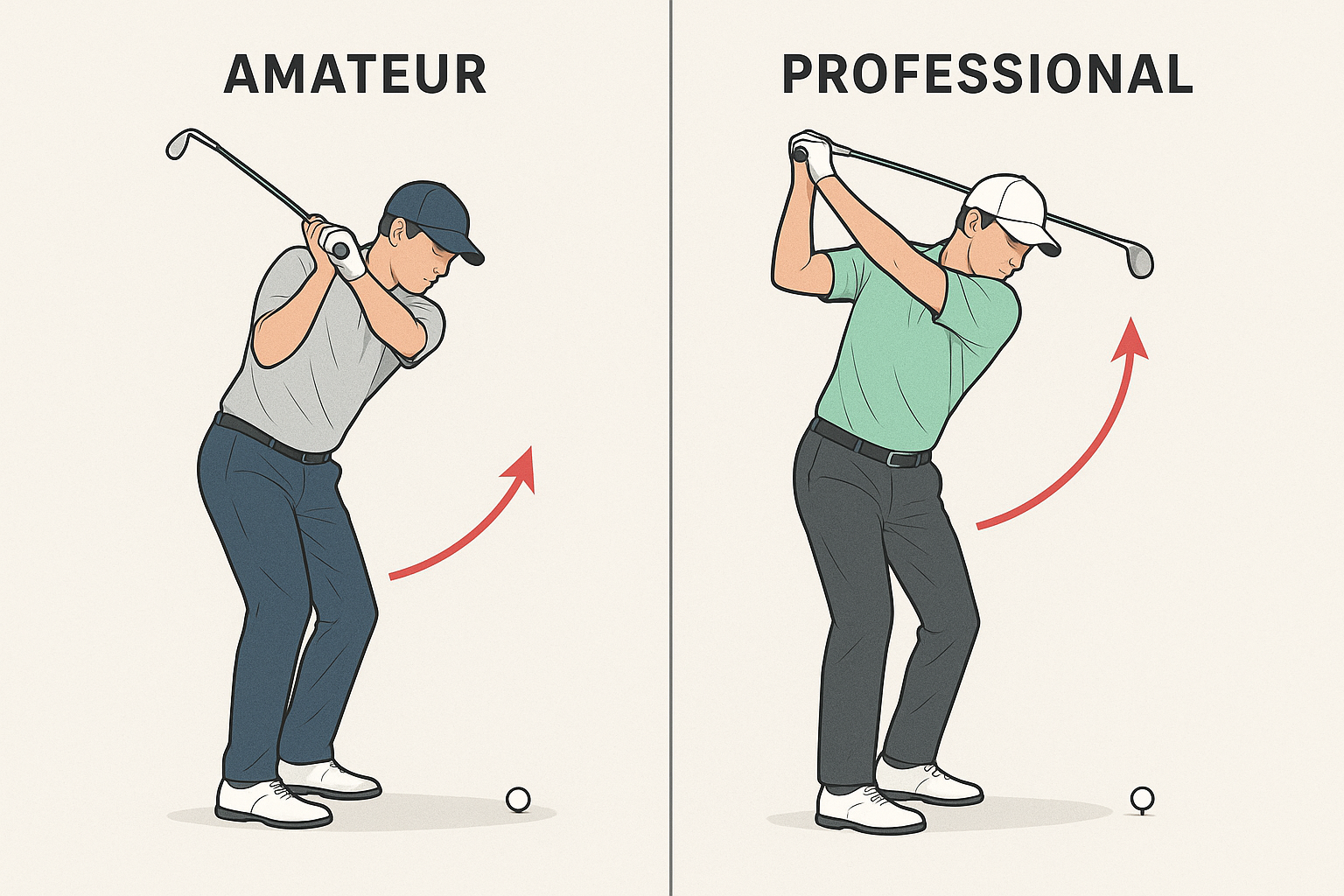
Side-by-side comparisons like this help golfers see exactly where sequencing breaks down.
Common Mistakes That Undermine Advanced Swing Mechanics
Even motivated players sabotage progress in predictable ways. For instance, many golfers copy a pro’s finish position without training the sequencing that creates it, which often produces compensations elsewhere in the swing. Others ignore their own mobility limits, forcing a position the body cannot safely support.
Moreover, competitive players sometimes change too many variables at once, making it impossible to know which adjustment actually helped. Instead, our guide on strategies for competitive golfers to improve fast recommends isolating one variable per training block.
Data point: Governing-body biomechanics research indicates elite golfers generate ground reaction forces during the downswing that meaningfully exceed those produced by amateur players, a key contributor to the distance gap between tour and club-level golfers. (Source: USGA)
Why Remote Coaching Can Reveal Swing Secrets for Pro Golfers
Historically, this level of analysis required travel to a handful of elite training facilities. Today, however, digital platforms remove that barrier. Coaching delivered by an LPGA Master Professional who also holds a PhD in kinesiology allows competitive amateurs, collegiate athletes, and aspiring professionals to access the same biomechanical analysis from anywhere.
This matters because local instructors, while often excellent for fundamentals, may lack the specialized training needed to diagnose subtle sequencing issues at an elite level. Consequently, remote, science-backed coaching fills a gap that many serious golfers cannot find nearby. A real-world example is documented in our case study of an experienced senior golfer who rebuilt swing consistency through targeted video analysis.

Ground force transfer through the feet is one of the least visible, most important swing secrets for pro golfers.
For golfers ready to apply these principles, our collection of exclusive golf tips and swing lessons offers a structured next step, and the yourgolfguru.com platform provides direct access to kinesiology-based remote coaching.
Frequently Asked Questions
What are swing secrets for pro golfers?
Swing secrets for pro golfers are evidence-based mechanics, such as ground force sequencing and hip-shoulder separation, that increase clubhead speed and accuracy while reducing injury risk. They are grounded in kinesiology rather than trial and error.
How do pro golfers improve swing consistency?
Pro golfers improve consistency through repeated practice of a fixed movement sequence, combined with video and motion analysis. This structured repetition builds reliable muscle memory under pressure.
Why do pro golfers use biomechanics-based coaching?
Biomechanics-based coaching identifies exactly which joints and muscles create power and where energy leaks occur. This precision helps pro golfers make targeted adjustments instead of guessing at swing changes.
What is the difference between amateur and pro golf swings?
Pro swings sequence the hips, torso, arms, and club in a strict order and generate more ground reaction force. Amateur swings often fire these segments together, which limits both speed and control.
How much does professional swing coaching cost?
Costs vary widely, from group clinics under $100 to private biomechanics-based packages priced in the hundreds per month. Remote online coaching often costs less than in-person elite instruction because it removes travel and facility overhead.
How long does it take to see swing improvement?
Most competitive golfers notice measurable changes in ball flight within four to six weeks of focused practice. Fully ingraining a new movement pattern under tournament pressure usually takes several months.
What are common mistakes when trying to copy pro golfer swings?
A common mistake is copying a pro’s finish position without training the sequencing that creates it. Another is ignoring individual mobility limits, which forces a position the body cannot safely support.
What is the best practice for learning swing secrets for pro golfers online?
The best practice is to submit swing video from multiple angles and work with a qualified coach who assesses joint sequencing rather than surface appearance. Consistent feedback loops matter more than the volume of tips consumed.
Can remote online coaching really teach pro-level swing mechanics?
Yes, remote coaching can teach pro-level mechanics when it uses detailed video analysis and structured drills. The core biomechanical principles do not require in-person observation to apply correctly.
What role does kinesiology play in golf swing training?
Kinesiology, the scientific study of human movement, explains how joints, muscles, and forces interact during the swing. This knowledge lets coaches design drills that build power safely instead of relying on generic tips.
Do collegiate and competitive amateur golfers need different coaching than recreational players?
Yes, competitive players typically need coaching focused on fine-tuning existing mechanics and performing under pressure. Recreational players often need foundational technique first, so the coaching priorities differ significantly.
What equipment or analysis tools help reveal swing secrets for pro golfers?
High-speed video, launch monitors, and force plates are commonly used because they measure sequencing and force output objectively. These tools remove guesswork from identifying swing flaws.
How often should serious golfers train these techniques?
Serious golfers generally benefit from practicing biomechanical drills three to five times per week alongside regular play. Consistent, focused repetition builds the movement patterns faster than occasional long sessions.
Final Takeaways
Ultimately, the swing secrets for pro golfers come down to sequencing, timing, and safe repeatable mechanics rather than talent alone. As shown throughout this article, ground force transfer, hip-shoulder separation, and consistent tempo form the backbone of elite ball-striking, and each can be trained deliberately with the right feedback. Therefore, competitive amateurs, collegiate players, and aspiring professionals who want this level of insight no longer need to rely solely on local instruction. In summary, science-backed remote coaching, like the kinesiology-based programs at yourgolfguru.com, offers a practical path toward applying these swing secrets for pro golfers to your own game, no matter where you are training.