


Injury prevention golf exercises are the difference between a swing that holds up for decades and one that breaks down under repeated stress. Because the golf swing asks the spine, hips, and shoulders to rotate powerfully in a single plane thousands of times per season, targeted physical preparation matters just as much as technique. This guide breaks down what these exercises are, why they work, and how competitive players can build them into a sustainable training routine.
Quick Answer: Injury prevention golf exercises combine dynamic mobility, core stability, and rotational strength training to protect the joints most stressed by the swing, primarily the lower back, shoulders, and wrists. A consistent routine, done several times a week, measurably lowers injury risk while improving swing power.

A resistance band rotation drill is one of the most effective injury prevention golf exercises for building rotational control.
What Are Injury Prevention Golf Exercises?
Injury prevention golf exercises are movement drills designed specifically around the biomechanical demands of the golf swing. Unlike generic gym routines, they target the exact ranges of motion and stabilization patterns golfers repeat every round. As a result, they help correct the mobility restrictions and strength imbalances that commonly lead to overuse injuries.
Specifically, these exercises fall into three categories: dynamic mobility work, core and hip stability training, and rotational power development. In addition, they are typically sequenced so mobility comes first, followed by activation, and finally controlled strength work. This order mirrors how the body actually needs to prepare before generating swing speed.
Why Golfers Get Hurt: The Biomechanics Behind Common Injuries
Golf may look low-impact, but the swing generates significant rotational force through a narrow window of time. Consequently, the lumbar spine, lead shoulder, and trailing wrist absorb repeated stress with every shot. According to research summarized by the National Library of Medicine’s PubMed database, low back injuries account for a substantial share of all reported golf injuries, often linked to limited hip rotation and poor sequencing.
Furthermore, amateur golfers frequently compensate for restricted mobility by over-rotating the lower back instead of the hips. Over time, this compensation pattern creates chronic strain rather than a single acute event. Therefore, addressing mobility restrictions early is one of the most reliable forms of golf injury prevention available to competitive players.
For a deeper look at swing mechanics themselves, the Wikipedia overview of the golf swing illustrates just how many joints must coordinate in sequence during a single shot.
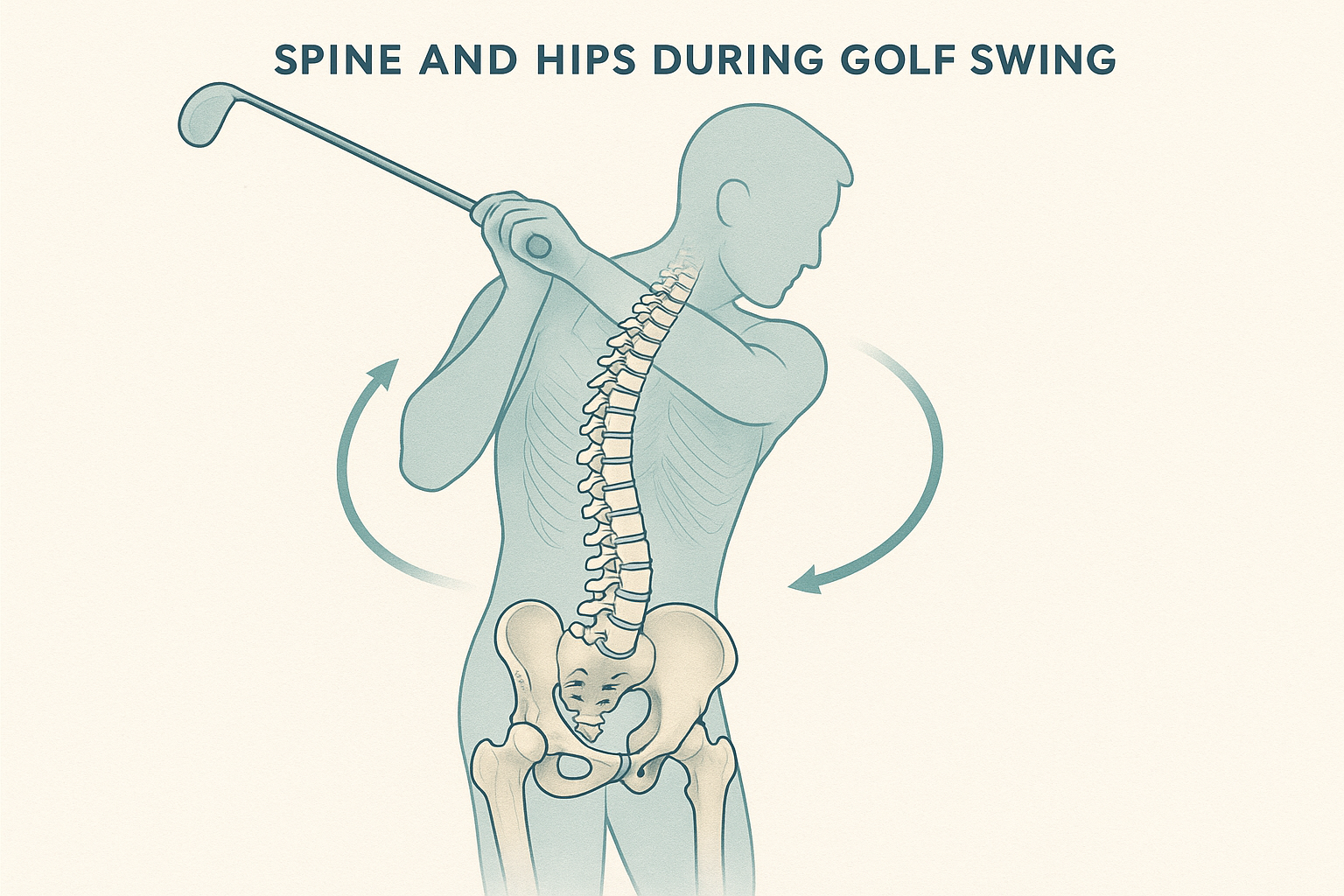
Understanding rotational stress points helps explain why golf injury prevention exercises focus heavily on the hips and lower back.
Core Categories of Golf-Specific Fitness Training
Effective programs blend three exercise categories, and each plays a distinct role in protecting the body while improving performance.
Mobility Drills
Hip openers, thoracic spine rotations, and shoulder circles restore the range of motion needed for an efficient, low-stress swing. Above all, mobility work should happen before every practice session, not just occasionally.
Stability and Core Strength
Planks, bird-dogs, and glute bridges build the stabilizing strength that keeps the spine safe during rotation. In particular, a strong core reduces reliance on the lower back to generate power, which directly lowers injury risk.
Rotational Power Work
Medicine ball throws and cable rotations train the body to generate speed safely through the same kinetic chain used in the swing. Similarly, this category should always follow mobility and stability work, never precede it.
How to Build a Safe Pre-Round Warm-Up Routine
A structured warm-up is one of the simplest, most effective forms of injury prevention golf exercises available to any player. The following sequence takes roughly fifteen minutes and can be done at the range or in a hotel room before a tournament round.
- Start with dynamic mobility movements. Spend three to five minutes on leg swings, hip circles, and arm crossovers to raise tissue temperature and open up joint range of motion.
- Activate the core and hips. Complete two sets of twelve glute bridges and standing pelvic tilts to engage the muscles that protect the lower back during rotation.
- Perform rotational drills. Use a resistance band or a light club for slow torso rotations, gradually increasing speed to rehearse safe sequencing.
- Rehearse slow-motion swings. Take five to ten half-speed practice swings, focusing on balance and tempo rather than distance.
- Finish with light cardio activation. Walk briskly or march in place for two minutes to fully prime the body before the first tee shot.
Common Mistakes That Increase Injury Risk
Many golfers unintentionally increase their own injury risk through avoidable habits. For instance, jumping straight into full-speed range sessions without any warm-up places sudden load on cold muscles and joints. Likewise, relying only on static stretching, rather than dynamic movement, can actually reduce power output right before play.
Another frequent mistake is training strength in isolation without addressing mobility restrictions first. As a result, added muscle mass without adequate range of motion can worsen compensation patterns instead of fixing them. Consequently, a balanced program that sequences mobility, stability, and power in the correct order is essential for lasting results.
Why Science-Backed Remote Coaching Improves Golf Injury Prevention
Because injury prevention depends on identifying individual mobility restrictions and swing compensations, generic exercise plans often fall short. This is where kinesiology-based coaching, the scientific study of human movement, adds real value. Programs like those detailed on injury prevention golf coaching designed to protect your swing combine video swing analysis with biomechanics training to pinpoint exactly where a golfer’s risk lies.
For competitive amateurs, collegiate athletes, and aspiring professionals, remote coaching removes geographic barriers entirely. A program built around golf injury prevention training that helps players swing safely and strong can be delivered anywhere with a video connection. Additionally, resources like a complete science-backed guide to golf-specific fitness training allow serious players to structure their own progressions between coaching sessions.
Ultimately, combining an LPGA Master Professional’s teaching experience with a PhD-level understanding of kinesiology allows for data-driven correction rather than guesswork. To explore a full framework for staying healthy long-term, the injury-free golf training guide offers additional structured programming. You can also visit the yourgolfguru.com homepage to see the full range of remote coaching options available.

Remote video analysis allows coaches to tailor injury prevention golf exercises to each player’s specific mobility needs.
Frequently Asked Questions About Injury Prevention Golf Exercises
What are injury prevention golf exercises?
Injury prevention golf exercises are targeted mobility, stability, and strength drills designed to prepare the joints and muscles used in the golf swing for repetitive rotational stress. They reduce strain on the lower back, shoulders, and wrists while improving swing efficiency.
How often should golfers do injury prevention exercises?
Most golfers benefit from a short mobility routine before every round or practice session, plus two to three dedicated strength sessions per week. Consistency matters more than intensity for long-term durability.
Why do golfers get injured even with good technique?
Even technically sound swings place asymmetrical, repetitive loads on the spine and hips, so limited mobility or weak stabilizing muscles can still lead to injury. Physical readiness matters as much as swing mechanics.
What is the difference between golf-specific fitness training and general strength training?
Golf-specific fitness training targets the rotational, single-plane, and stabilization demands unique to the swing, while general strength training builds overall muscle mass without addressing golf’s biomechanical patterns. A golf-specific program directly supports injury prevention and clubhead speed.
How long does it take to see results from an injury prevention program?
Golfers often notice improved mobility and reduced soreness within two to four weeks of consistent practice. Measurable gains in swing power and stability typically appear after eight to twelve weeks.
What are the most common golf injuries?
Low back pain, golfer’s elbow, shoulder impingement, and wrist strain are among the most frequently reported golf injuries. Most stem from repetitive rotational loading combined with limited mobility or poor sequencing.
Do professional golfers need injury prevention exercises too?
Yes, professional and collegiate golfers often need injury prevention exercises even more than recreational players because of higher swing volume and competitive demands. Elite coaching typically includes structured mobility and stability work year-round.
What equipment do I need for golf injury prevention exercises?
Many injury prevention golf exercises require only bodyweight, a resistance band, and a stability ball. As programs progress, light dumbbells or a cable machine can add targeted rotational resistance.
Can online coaching really help prevent golf injuries?
Yes, remote video-based coaching can identify swing faults and physical limitations that contribute to injury risk just as effectively as in-person sessions. A kinesiology-trained coach can prescribe corrective exercises based on video analysis and reported mobility restrictions.
What are common mistakes golfers make with warm-ups?
The most common mistake is skipping mobility work entirely and going straight to full-speed swings on the range. Static stretching before play, rather than dynamic movement, is another frequent error that can reduce power output.
How much does working with a golf-specific kinesiology coach cost?
Costs vary widely depending on program depth, ranging from single video assessments to ongoing monthly coaching subscriptions. Remote programs generally cost less than in-person biomechanics labs while still offering data-driven feedback.
What is the best time to do these exercises, before or after a round?
Dynamic mobility and activation drills work best before a round to prepare the body for rotational stress. Strength and flexibility training are better suited for after play or on separate training days.
Are injury prevention exercises different for collegiate or competitive players?
Competitive and collegiate players typically need higher training volume and more advanced rotational power work due to increased practice frequency. Programs for this group often integrate periodization to manage fatigue across a long season.
Final Thoughts
In summary, injury prevention golf exercises are not optional extras; they are a core part of any serious performance plan. By combining dynamic mobility, core stability, and rotational strength work, golfers can significantly lower their risk of overuse injuries while unlocking more consistent power. Above all, addressing physical limitations alongside swing mechanics, ideally with kinesiology-informed guidance, gives competitive players the best chance at a long, healthy playing career.