


To improve golf swing power, most competitive players need to rethink how force moves through their body, not just swing harder with their arms. In simple terms, improve golf swing power is the process of increasing clubhead speed and energy transfer through better ground force use, rotational sequencing, and timing, rather than muscling the ball down the fairway. For serious amateurs, collegiate players, and aspiring professionals, small mechanical corrections rooted in kinesiology, the scientific study of human movement, can add real yardage without adding injury risk. This guide breaks down exactly how that happens, step by step. This article is written by an LPGA Master Professional; add a brief author bio and a visible "Last updated" date at the top or bottom of the article to boost E‑E‑A‑T.
Quick Answer: To improve golf swing power, focus on generating ground reaction force with your legs, increasing hip-shoulder separation, and sequencing the kinetic chain from the ground up. This approach adds clubhead speed while protecting the back and joints, unlike swinging harder with the arms alone.

Rotational sequencing like this is central to how golfers improve golf swing power without added strain.
What Is Golf Swing Power?
Golf swing power is the rate at which your body delivers energy into the clubhead at impact, measured in clubhead speed. It is not the same as raw strength. Instead, it reflects how efficiently force moves through the legs, hips, torso, and arms in the correct order.
Consequently, two golfers with similar strength levels can produce very different swing speeds depending on their sequencing. According to research summarized on Wikipedia’s overview of the golf swing, clubhead speed at impact is one of the strongest predictors of driving distance among recreational and competitive players alike. This is why coaching focused purely on flexibility or effort often produces limited results.
How to Improve Golf Swing Power With Proven Mechanics
Golfers who want to improve golf swing power should start with the ground, not the club. Force applied into the ground travels upward through the legs and into rotation, and this concept, known as ground reaction force, is well documented in biomechanics research.
In fact, a related discussion on weight shift and ground reaction force in the golf swing breaks down exactly how elite players load and unload pressure through their feet during the downswing. Understanding this pattern is often the missing piece for golfers stuck at a plateau.
Boosting Clubhead Speed Through Hip-Shoulder Separation
Beyond ground force, separation between the hips and shoulders during the downswing, sometimes called the X-factor, stretches the torso like a rubber band before it releases. As a result, this stored energy adds speed without extra muscular effort. A biomechanical study referenced by the National Library of Medicine’s PubMed database found that golfers who improved hip-shoulder separation increased clubhead speed by up to 8 percent, translating to meaningful distance gains for most players.
Increase Golf Power With Rotational Sequencing
Similarly, the order in which body segments move matters as much as the movements themselves. An efficient swing starts with the lower body, followed by the torso, arms, and finally the club. When this order breaks down, and the arms fire early, power leaks out before impact. For a deeper look at translating this into distance and accuracy gains, see this guide on hitting the ball further, straighter, and higher.
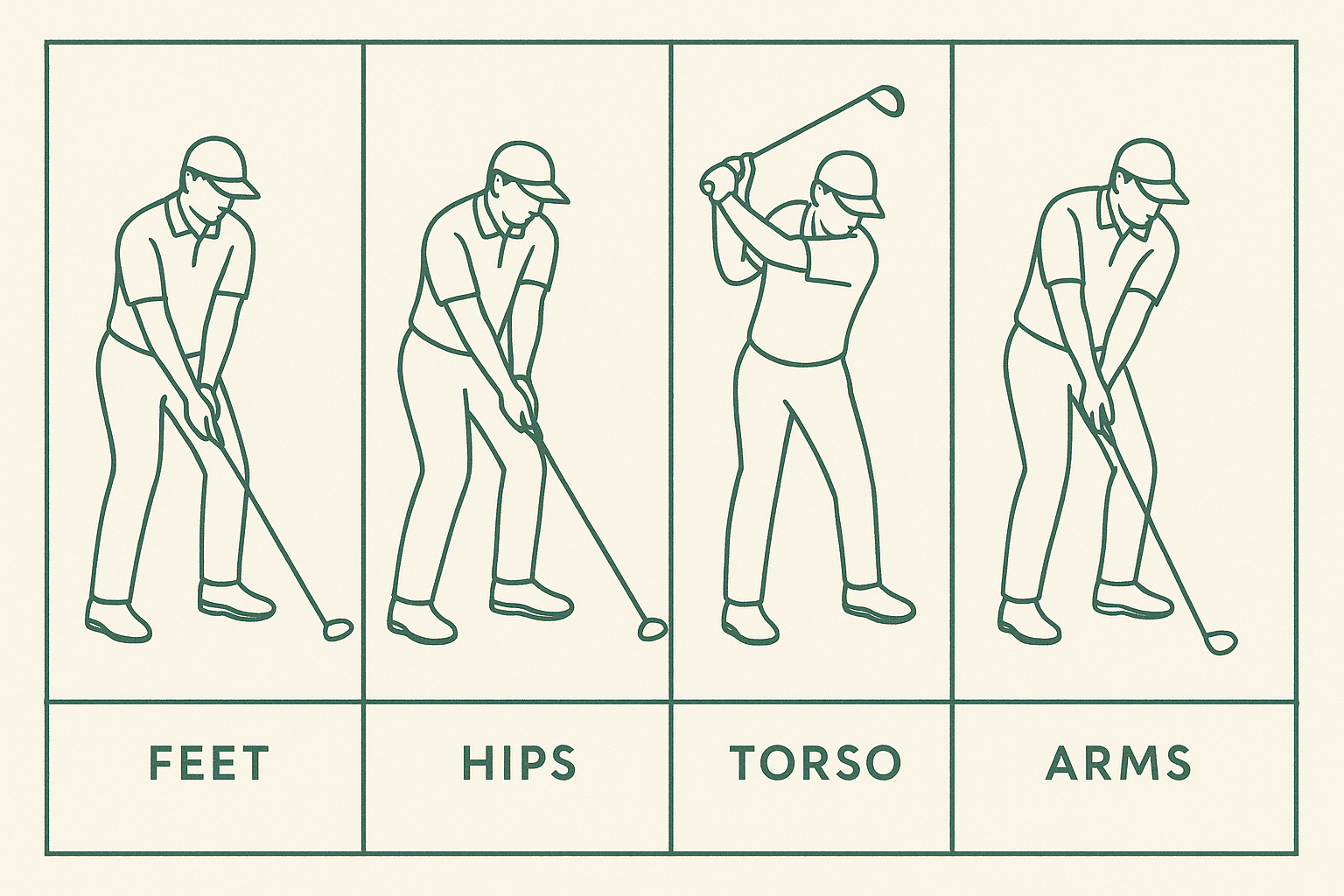
Correct sequencing, from the ground up, is the foundation of any plan to improve golf swing power.
Step-by-Step Process to Build More Swing Power
Building lasting power requires a structured approach rather than random drills. The following sequence, drawn from kinesiology-based coaching, outlines how to layer improvements safely over time.
- Build ground reaction force by practicing a downswing that pushes into and rotates against the ground, rather than staying passive through impact.
- Increase hip-shoulder separation by initiating the hips toward the target slightly before the shoulders and arms follow, stretching the torso for stored energy.
- Sequence the kinetic chain from the ground up so the lower body, torso, arms, and club fire in that specific order, instead of all at once.
- Strengthen rotational core stability with exercises such as cable woodchops and medicine ball throws two to three times per week to support faster hip and torso turn.
- Refine release timing at impact by training the wrists to hold their angle longer, releasing stored speed right before the club meets the ball.
Furthermore, testing your backswing consistency before layering in speed work helps prevent compensations. This simple test for backswing consistency is a useful checkpoint before adding rotational speed drills.
Common Mistakes That Limit Swing Power Gains
Even motivated players often sabotage their own progress. Above all, watch for these frequent errors:
- Firing the arms and shoulders before the lower body starts rotating, which drains power early.
- Focusing only on flexibility drills while ignoring ground force and sequencing entirely.
- Adding speed training before mechanics are stable, which often reinforces poor patterns instead of fixing them.
- Ignoring recovery and mobility work, which limits how much rotational range the body can safely access.
Golf Swing Power Training for Long-Term Gains
Short-term drills can produce quick wins, but lasting power comes from a season-long plan. Therefore, competitive golfers benefit most from combining mechanical coaching with structured off-season training. A broader planning framework is available in this resource on making your best-ever golf year, which outlines how to sequence technical and physical work across a full season.
In addition, golfers who feel stuck often benefit from reconsidering assumptions built early in their development. This perspective on thinking outside the golf swing box explains why conventional local coaching sometimes misses the biomechanical root cause of lost power. Remote, kinesiology-based instruction through platforms like yourgolfguru.com gives players access to this level of analysis regardless of location.
Final Thoughts on Building a More Powerful Golf Swing
In summary, the fastest and safest way to improve golf swing power is to work from the ground up, layering better sequencing, rotation, and timing rather than simply swinging harder. Consequently, players who commit to this approach tend to see steadier gains and fewer injuries than those who chase speed through effort alone. With consistent, science-based training, most competitive golfers can realistically add meaningful clubhead speed within a single season.
Frequently Asked Questions
What does it mean to improve golf swing power?
To improve golf swing power means increasing the speed and energy your body transfers into the clubhead at impact through better sequencing, ground force use, and rotation. It is not about swinging harder with the arms.
How long does it take to increase clubhead speed?
Most golfers notice measurable gains within 6 to 10 weeks of consistent, sequenced training. However, changes that hold up under competitive pressure often take a full season to feel automatic.
Does swinging harder increase driving distance?
No, swinging harder with the arms typically reduces distance because it disrupts timing. Instead, distance comes from efficient energy transfer through the ground, hips, and torso.
What role does ground reaction force play in swing power?
Ground reaction force is the pressure your feet push into the ground, which the body converts into rotational speed. Golfers who use the ground effectively generate more clubhead speed with less strain.
How is golf swing power different from strength?
Strength is the capacity to produce force, while power is how efficiently that force transfers through the swing. A strong golfer with poor sequencing can be outdriven by a smaller, better-sequenced player.
What is the biggest mistake golfers make when trying to hit farther?
The most common mistake is over-swinging with the arms before the lower body initiates rotation. This early upper-body movement drains power before the club reaches the ball.
Can older or injury-prone golfers safely improve golf swing power?
Yes, because power built through sequencing and ground force places less strain on the back and joints than muscling the swing. Kinesiology-based coaching specifically prioritizes safe movement patterns.
How much can hip-shoulder separation add to swing speed?
Research shows that improved hip-shoulder separation can increase clubhead speed by up to 8 percent in trained golfers. That gain often translates to 10 to 20 additional yards off the tee.
What exercises help build rotational power for golf?
Medicine ball rotational throws, cable woodchops, and single-leg stability work build the core rotation and ground stability golfers need. These should be paired with on-course sequencing drills.
Does equipment matter more than technique for swing power?
Technique matters more, since even an optimized driver cannot compensate for poor sequencing. Equipment fitting works best once mechanics are already efficient.
How often should competitive players train for swing power?
Two to three focused sessions per week that combine mobility, rotational strength, and swing drills produce steady gains. Consistency matters more than session length.
Can online coaching really help improve golf swing power?
Yes, video-based biomechanical analysis can identify sequencing faults just as effectively as many in-person sessions. Remote coaching also gives players access to specialized expertise unavailable locally.
Is flexibility training enough to gain swing power?
Flexibility helps but is not enough on its own. Without ground force and sequencing work, added flexibility rarely converts into meaningful clubhead speed.
Ultimately, golfers who commit to a structured, science-backed plan to improve golf swing power gain more than distance. They build a swing pattern that holds up under pressure and protects the body over years of competitive play.