


Learning how to improve golf swing consistency is the single question that separates streaky ball-strikers from players who shoot low scores week after week. Golf swing consistency is the ability to repeat a biomechanically efficient motion swing after swing, regardless of nerves, fatigue, or course conditions. However, consistency is not reserved for tour professionals with unlimited practice time. In fact, research-backed coaching methods, like those used by LPGA Master Professionals, show that swing repeatability is a trainable skill built on measurable fundamentals rather than natural talent alone.
Quick answer: To improve golf swing consistency, focus on repeatable setup positions, a stable spine angle, and sequencing the downswing from the ground up, then reinforce those patterns with feedback-based practice such as video review or sensor data. Most golfers see measurable improvement in dispersion and contact quality within four to eight weeks of deliberate, structured practice.
What Is Golf Swing Consistency?
Golf swing consistency is the repeatable execution of the same swing mechanics, grip, posture, takeaway, transition, and impact position, across multiple shots and playing conditions. Rather than meaning a “perfect” swing, consistency refers to minimizing variability in the factors that matter most: clubface angle, swing path, and strike location.
For example, a golfer with high swing consistency may not have textbook form, but their clubhead arrives at impact in nearly the same position every time. In contrast, inconsistent golfers often change their swing shape from shot to shot, which produces unpredictable ball flight. Understanding this distinction matters because it shifts the training focus from aesthetics toward repeatable, measurable outcomes. A related concept worth reviewing is explored in Tiger and You, which looks at how even elite players study their own swing history to stay repeatable.

A repeatable downswing position, powered by the hips rather than the arms, is the foundation of golf swing consistency.
Why Does Golf Swing Consistency Break Down?
Several factors erode swing consistency, even among skilled players. Fatigue, for instance, alters muscle sequencing late in a round, causing subtle timing shifts that change contact quality. Similarly, swing changes made without biomechanical context, such as copying a tour pro’s position without understanding why it works for their body, often create new compensations instead of fixing the root cause.
Nerves and course pressure also play a role, tightening the grip and shortening the backswing just enough to throw off a well-grooved pattern. Above all, generic instruction that ignores an individual golfer’s joint mobility, strength, and movement history tends to produce short-lived fixes. As a result, many competitive players bounce between swing thoughts without ever addressing the underlying mechanical or physical limitation causing the breakdown. According to PGA Tour driving accuracy statistics, tour professionals hit fairways roughly 60 percent of the time, while recreational golfers average under 40 percent, a gap driven largely by repeatability rather than raw swing speed.
How to Improve Golf Swing Consistency With a Science-Based Approach
How to improve golf swing consistency comes down to combining biomechanical awareness with deliberate, feedback-driven practice. Rather than hunting for a single swing tip, golfers benefit most from a structured process that addresses setup, sequencing, and physical constraints together. Below is a step-by-step framework used in kinesiology-informed golf instruction to help competitive players build a swing that holds up under pressure.
5 Steps to a More Repeatable Golf Swing
- Audit your setup fundamentals. Check grip pressure, stance width, and spine angle at address, since even small setup variations change the swing plane before the club ever moves.
- Record your swing from two angles. Film face-on and down-the-line views regularly so you can compare today’s swing to your baseline and catch drift before it becomes a habit.
- Train the transition, not just the backswing. Focus practice reps on the pause-and-shift moment at the top of the swing, because inconsistent sequencing here causes most compensations lower in the swing.
- Build physical capacity for your swing pattern. Work on hip rotation, thoracic mobility, and core stability, since physical limitations often force compensations that feel random but are actually mechanical.
- Practice with purpose and feedback. Use alignment sticks, impact tape, or launch monitor data during range sessions instead of simply hitting balls, since feedback accelerates how quickly a pattern becomes automatic.
The Role of Biomechanics in a Consistent Golf Swing
Biomechanics, the study of how the body produces movement (Wikipedia), explains why two golfers with similar swings can have very different levels of consistency. Specifically, factors like hip-shoulder separation, ground reaction forces, and joint sequencing determine how repeatable a swing can be under fatigue or pressure.
For example, a golfer with limited thoracic rotation may compensate with excessive arm swing, which is harder to repeat than a swing powered by the larger, more reliable muscles of the hips and core. This is why instruction grounded in kinesiology, the science of human movement (Wikipedia), tends to produce more durable results than generic tips. For a deeper look at how biomechanical sequencing affects power and repeatability, see this guide on scientific golf swing moves. Coaches with a kinesiology background, such as those on the Your Golf Guru platform, can identify which physical constraints are limiting a player’s consistency rather than guessing from video alone.
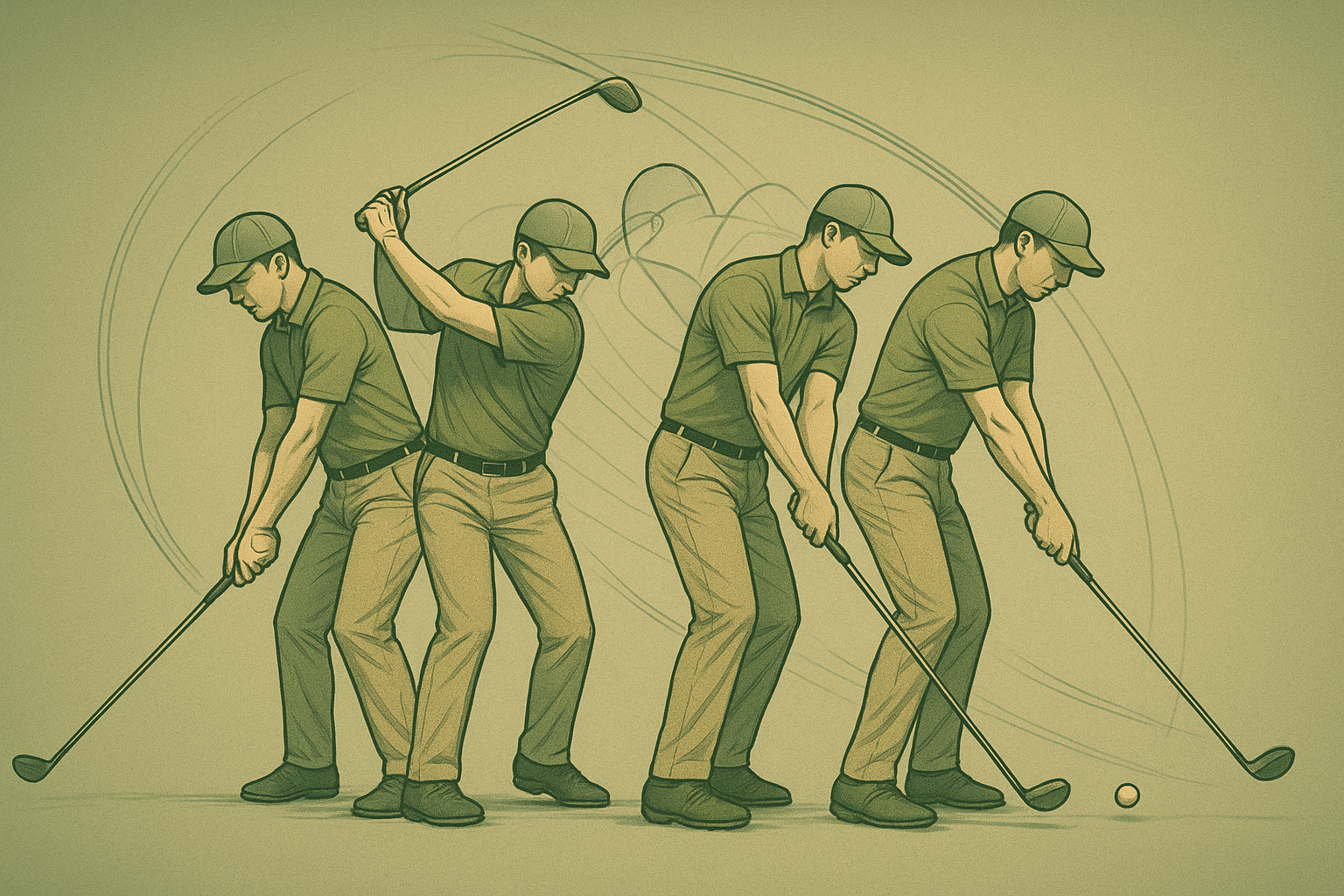
Biomechanical sequencing, not just arm speed, drives a consistent golf swing from the ground up.
Common Mistakes That Hurt Swing Consistency
Many golfers unintentionally sabotage their own consistency. Overcorrecting after one bad shot, for instance, often introduces a second swing flaw on top of the first. In addition, practicing exclusively with a driver reinforces big, uncontrolled movements rather than the smaller, repeatable motions needed for iron play and short game precision.
Ignoring tempo is another common issue; rushing the backswing under pressure changes sequencing enough to shift impact location. Finally, skipping a simple backswing checkpoint is a frequent culprit. If you want a quick way to test this, try the approach outlined in this simple backswing consistency test. Addressing these habits early prevents them from becoming permanent compensations that are far harder to unwind later.
Drills to Build a More Consistent Golf Swing
Specific drills reinforce the mechanical changes discussed above far faster than swing thoughts alone. The step-drill, where a golfer takes a small step toward the target during the downswing, helps groove proper weight transfer. Similarly, the headcover-under-the-arm drill encourages connected arm and torso movement, reducing the arm-dominant swings that are notoriously hard to repeat.
Alignment stick gates placed just outside the ball help golfers monitor swing path on every rep, providing instant feedback instead of guessing. For golfers who want a full progression of these drills alongside swing analysis, the lessons available through exclusive golf tips and swing lessons walk through each movement in more depth. Above all, consistency improves fastest when drills are practiced slowly first, then gradually sped up once the pattern feels automatic rather than forced.

Simple feedback tools like alignment sticks make swing path errors visible on every repetition.
Frequently Asked Questions About Golf Swing Consistency
What is golf swing consistency?
Golf swing consistency is the ability to repeat the same efficient swing mechanics, grip, sequencing, and impact position, shot after shot, regardless of pressure or fatigue. It is measured less by how a swing looks and more by how little the clubface angle and path vary between repetitions.
How to improve golf swing consistency the fastest way?
The fastest way to improve golf swing consistency is to combine structured practice with objective feedback, such as video review, launch monitor data, or guided instruction from a qualified coach. Addressing setup and sequencing first produces quicker gains than chasing isolated swing tips.
Why does my golf swing feel different every round?
Swing feel changes round to round due to fatigue, nerves, warm-up quality, and even small equipment differences like grip wear. Relying on measurable checkpoints rather than sensation alone helps maintain a more consistent swing under varying conditions.
How long does it take to build a consistent golf swing?
Most golfers notice measurable improvement in dispersion and contact quality within four to eight weeks of deliberate, feedback-driven practice. However, fully automating a new movement pattern under tournament pressure can take several months of repetition.
What drills improve swing consistency the most?
Drills that reinforce proper sequencing and weight transfer, such as the step-drill and alignment-stick gates, tend to produce the fastest consistency gains. These drills work because they give immediate feedback on swing path and timing rather than relying on feel alone.
Is golf swing consistency more about tempo or mechanics?
Both matter, but mechanics generally take priority, since flawed sequencing can undo even a smooth tempo. That said, tempo variations under pressure are often the trigger that exposes an underlying mechanical weakness.
How much does online golf coaching for swing consistency cost?
Pricing varies by provider and the depth of analysis offered, ranging from single video reviews to ongoing coaching programs. Programs that include biomechanical assessment, like those built around kinesiology-based instruction, typically sit at a higher tier than generic tip-based lessons.
What are the most common mistakes that hurt swing consistency?
Overcorrecting after a single bad shot, practicing only with a driver, and ignoring tempo under pressure are among the most common mistakes. Each of these habits introduces new compensations instead of resolving the original inconsistency.
Can equipment affect golf swing consistency?
Yes, poorly fitted clubs can force compensations in posture or swing path that are difficult to repeat. Shaft length, lie angle, and grip size should match the golfer’s body and swing pattern rather than being chosen generically.
Does fatigue really affect swing consistency?
Fatigue reduces muscle control and alters sequencing, particularly in the hips and core, which changes the timing of the downswing. This is why consistency often declines noticeably late in a round or tournament, a pattern documented in sports science research on PubMed.
Should I film my swing to improve consistency?
Filming your swing from face-on and down-the-line angles is one of the simplest ways to catch drift before it becomes a permanent habit. Comparing footage to a known baseline makes it easier to identify what changed between a good round and a bad one.
What role does a coach’s background play in building swing consistency?
A coach with a kinesiology or biomechanics background can identify physical limitations, such as restricted hip rotation, that generic instruction often misses. Addressing the root physical cause tends to produce more durable consistency than cosmetic swing adjustments.
Key Takeaways
In summary, learning how to improve golf swing consistency is less about finding a magic tip and more about combining repeatable fundamentals, biomechanical awareness, and feedback-driven practice. Golfers who address setup, sequencing, and physical capacity together tend to see faster, more durable results than those chasing isolated swing thoughts.
Therefore, treating consistency as a trainable skill, rather than a fixed trait, opens the door to steady improvement at any level of competition. For a deeper, science-based path forward, the resources at Your Golf Guru’s performance optimization guide and the coaching platform at yourgolfguru.com offer structured, kinesiology-informed instruction built for serious, competitive players.