


How to improve golf swing balance and stability is one of the most common questions competitive golfers ask once their ball-striking starts breaking down under pressure. Balance influences nearly every phase of the swing, from the first move away from the ball to the finish position. Even a small wobble in your base can cost you accuracy, distance, and consistency when it matters most. In this guide, you’ll find science-backed drills, common mistakes, and a clear step-by-step process you can start using in your very next practice session.
Quick Answer: To improve golf swing balance and stability, build a stable setup with even weight distribution, strengthen your core and glutes, and practice slow-motion or single-leg swings before adding speed. Consistent, biomechanically sound practice reduces the compensations that cause inconsistent contact and lost power.
What Is Golf Swing Balance and Stability?
Golf swing balance and stability is your body’s ability to control its center of mass throughout the entire swing motion, from address through follow-through. In other words, it is the foundation that allows every other swing mechanic to work correctly. When this foundation is solid, your spine angle, hip rotation, and weight transfer stay predictable, which directly supports consistent contact.
Without it, however, even technically sound swing mechanics tend to break down under speed or pressure. For instance, a golfer with excellent clubface control at slow speed may still slice or hook the ball once tempo increases, simply because their base can’t support the added rotational force.
Why Swing Stability Matters for Consistent Ball Striking
Consistency is the hallmark of a reliable golf swing, and stability is what makes consistency possible. Specifically, when your base stays steady, your swing plane and clubhead path repeat more reliably from shot to shot. As a result, you spend less time compensating mid-swing and more time trusting your mechanics.
In contrast, golfers who sway, slide excessively, or lift their head early often experience unpredictable ball flight because their center of gravity shifts at the wrong moment. According to research referenced in sports biomechanics literature, improved postural control has been linked to measurable gains in clubhead speed, sometimes in the range of several percentage points among trained athletes. Therefore, balance training isn’t just about avoiding mistakes; it’s also a legitimate path to more power.
Similarly, better stability reduces physical strain on the lower back and knees, which supports long-term injury prevention for competitive players who practice and compete frequently.

A balanced top-of-swing position sets the foundation for stable, repeatable ball striking.
The Biomechanics Behind a Stable Golf Swing
Understanding the biomechanics, meaning how your muscles, joints, and ground forces interact, helps explain why balance training works so well. Essentially, your swing is a chain reaction: the lower body creates a stable base, the core transfers force, and the arms and club deliver speed at impact. If any link in that chain is unstable, the entire sequence suffers.
Specifically, your ankles and feet provide proprioceptive feedback, meaning your brain’s awareness of body position in space, that helps you sense weight shifts before you even consciously notice them. Meanwhile, your glutes and hips stabilize rotation, and your core prevents your upper body from outrunning your lower body during the downswing. For a deeper look at how modern swing science applies to elite performance, the latest research on golf swing biomechanics breaks down these relationships in more detail.
Notably, the Wikipedia overview of balance as a physical ability explains how the vestibular system, vision, and proprioception work together to maintain equilibrium, a concept directly relevant to golf performance.
How to Improve Golf Swing Balance and Stability: Step-by-Step Drills
Now that you understand why balance matters, here is a practical, sequenced approach for how to improve golf swing balance and stability. Each step builds on the previous one, so it’s best to work through them in order rather than skipping ahead to full-speed practice.
- Assess your current balance baseline. Record your swing from face-on and down-the-line angles to check whether your head, hips, and spine angle stay consistent from address to finish.
- Build a stable setup and weight distribution. Set your feet shoulder-width apart, distribute weight evenly between both feet, and flex your knees slightly to create a balanced, athletic starting position.
- Strengthen your core and lower body. Add glute bridges, planks, and single-leg deadlifts to your weekly routine to build the muscular support needed to resist sway and slide during rotation.
- Practice single-leg and slow-motion swings. Swing at half speed while lifting your trail foot slightly off the ground through impact, holding the finish position for three full seconds to reinforce control.
- Train dynamic balance at full speed. Gradually increase swing speed while maintaining the same balanced finish, using video feedback to confirm your center of gravity stays stable under full effort.
Above all, patience matters here. Rushing this progression often reinforces the very compensations you’re trying to eliminate, so give each step at least one full week before advancing.
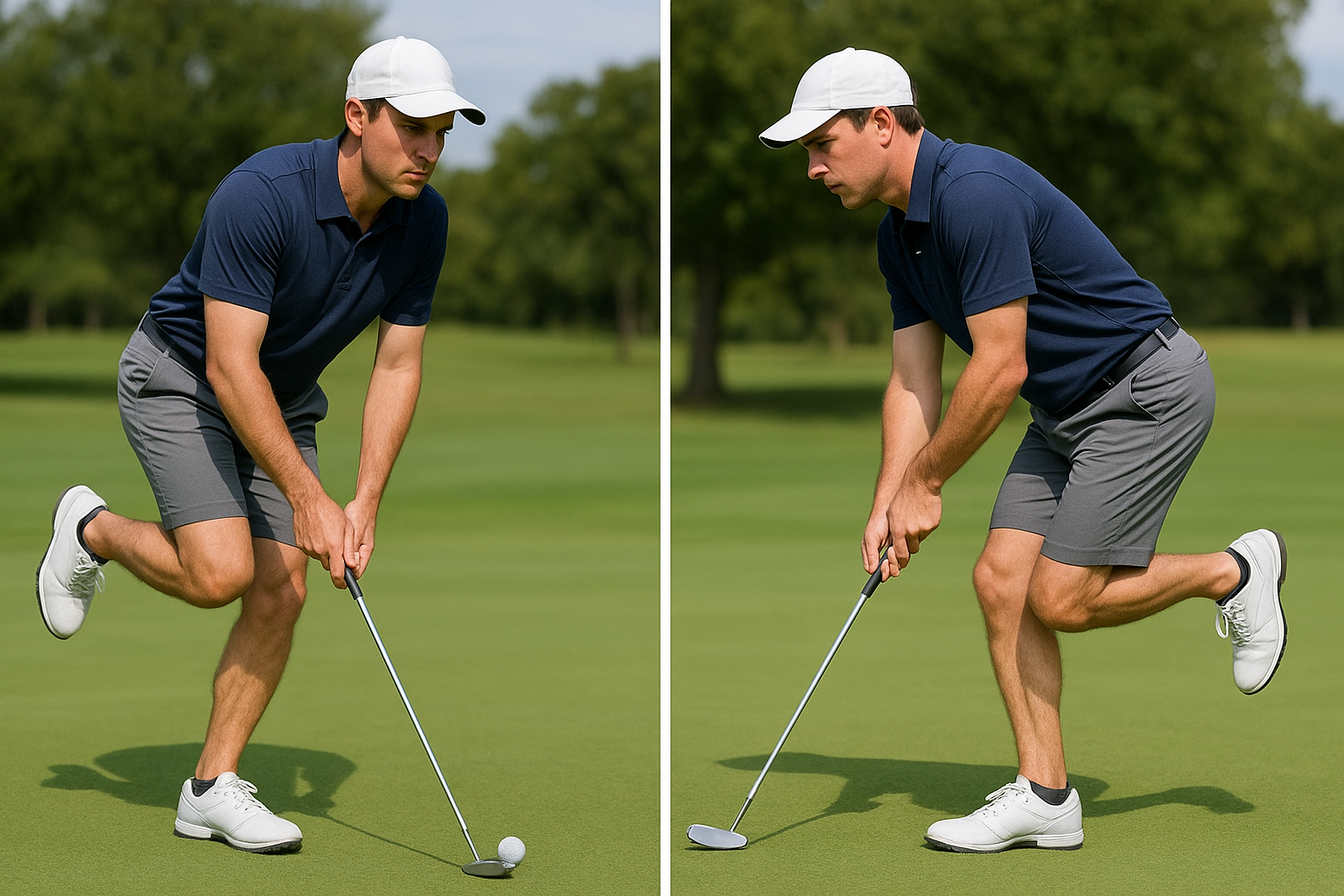
Single-leg drills like this one are a core part of learning how to improve golf swing balance and stability over time.
Common Mistakes That Wreck Swing Balance
Even motivated golfers sabotage their own balance without realizing it. For example, excessive lateral sway during the backswing shifts weight too far outside the trail foot, which then forces a reactive lunge back toward the target on the downswing.
Likewise, rushing the transition, meaning starting the downswing before the backswing fully completes, creates a timing mismatch that destabilizes the entire kinetic chain. Similarly, lifting the head or standing up out of posture too early changes the spine angle and throws off the swing plane at the worst possible moment.
If you’re unsure which mistake applies to you, a simple backswing consistency test can help you identify where your balance breaks down before you ever reach impact.
Training Tools and Technology for Better Stability
Technology has made balance training far more precise than it used to be. Force plates, for instance, measure how weight shifts between feet in real time, while video overlay software can visually flag sway, slide, or early extension. However, most competitive golfers don’t have daily access to a biomechanics lab, which is exactly why remote, expert-guided coaching has become so valuable.
At yourgolfguru.com, instruction is built around exactly this gap. Lessons are developed by an LPGA Master Professional who also holds a PhD in kinesiology, combining biomechanical science with decades of elite teaching experience to deliver data-driven feedback remotely. This approach allows competitive amateurs, collegiate players, and aspiring professionals to receive advanced technical guidance without traveling to a physical facility.
Furthermore, golfers interested in translating balance improvements into more distance can explore how stability connects to power in the guide on how to hit the ball further, straighter, and higher, while those curious about full performance training can review this science-based performance optimization guide.
Learning From Elite Swing Models
Studying elite swings can also reinforce good balance habits, provided you focus on principles rather than copying positions blindly. Many tour-level players share similar fundamentals: a stable base, controlled transition, and a balanced finish, even though their swings look visually different.
For a closer look at how these fundamentals apply across skill levels, the comparison in Tiger and You breaks down how elite mechanics translate into practical lessons for everyday competitive players. Meanwhile, understanding core kinesiology concepts, as outlined on Wikipedia’s kinesiology overview, can deepen your appreciation for why these balance principles hold true across different body types and swing styles.
In addition, the National Institutes of Health publishes general guidance on balance and proprioceptive training, which, while not golf-specific, supports the broader physiological case for why stability drills improve athletic performance.
Frequently Asked Questions
What is golf swing balance and stability?
Golf swing balance and stability refers to your body’s ability to control its center of gravity throughout the backswing, downswing, and follow-through. Good balance keeps your spine angle and weight distribution consistent, which supports repeatable, accurate contact.
How do I improve golf swing balance and stability quickly?
The fastest way to improve golf swing balance and stability is to practice slow-motion swings while holding your finish position for three seconds. Pairing this with single-leg balance drills trains your core and lower body to control movement rather than react to it.
Why does poor balance cause inconsistent golf shots?
Poor balance forces your body to make last-second compensations during the downswing, which changes clubface angle and swing path. Even a slight shift in your center of mass can produce fat shots, thin contact, or inconsistent ball flight.
What muscles are most important for golf swing stability?
The glutes, core, and ankle stabilizers play the biggest role in swing stability because they anchor your base while your upper body rotates. Strengthening these muscle groups reduces unwanted sway and slide during the swing.
How long does it take to improve swing balance?
Most golfers notice measurable improvement in balance within four to six weeks of consistent drill work, though full integration into a full-speed swing can take longer. Progress depends largely on practice frequency and whether drills are performed under realistic swing speeds.
Can balance training increase clubhead speed?
Yes, improved postural control allows golfers to rotate more aggressively without losing their base, which research has linked to measurable clubhead speed gains. A stable foundation lets the body transfer ground force into the swing more efficiently.
What drills improve balance in a golf swing?
Effective drills include single-leg swings, slow-motion swings with a three-second finish hold, and feet-together swings that remove excess lower body movement. These drills isolate balance so the body learns to stabilize before adding full swing speed.
Is weight distribution the same for every golfer?
No, ideal weight distribution varies slightly based on body type, flexibility, and swing style, though most golfers benefit from a balanced setup that shifts dynamically through the swing. A qualified coach can help identify the right pattern for your specific mechanics.
How does core strength affect swing stability?
A strong core connects the lower body’s stable base to the upper body’s rotational power, preventing energy leaks during the downswing. Without adequate core strength, golfers often compensate with excessive arm action, which reduces consistency.
What mistakes ruin golf swing balance?
Common mistakes include swaying off the ball instead of rotating, lifting the head too early, and rushing the transition from backswing to downswing. Each of these errors shifts the center of gravity away from a stable base.
Do professional golfers struggle with balance issues?
Even elite players occasionally fight balance issues, particularly under fatigue or when making swing changes, though their baseline stability is far more refined than amateur golfers. Ongoing biomechanical training helps professionals maintain balance under competitive pressure.
Should beginners focus on balance before power?
Yes, building balance first gives beginners a stable platform to safely add power and speed later without reinforcing compensations. Trying to generate power before establishing balance often leads to injury and inconsistent ball striking.
How can online golf coaching help with swing stability?
Online coaching from a credentialed instructor allows golfers to receive biomechanical feedback on balance and stability without traveling to a physical facility. Video analysis combined with kinesiology-based coaching can identify subtle balance flaws that are difficult to self-diagnose alone.
Final Thoughts
Ultimately, learning how to improve golf swing balance and stability comes down to building a reliable foundation first, then layering speed and power on top of it. Start with an honest assessment of your current setup, strengthen the muscles that support rotation, and progress through slow-motion drills before testing everything at full speed. Consequently, you’ll spend less time compensating mid-swing and more time trusting a repeatable motion under pressure. For golfers serious about long-term, science-backed improvement, pairing this approach with expert, biomechanics-based coaching can turn balance from a weakness into a genuine competitive advantage.