


Golf swing mechanics refer to the sequence of body positions and movement patterns that generate clubhead speed, control the clubface, and produce a repeatable ball flight. For competitive amateurs, collegiate players, and aspiring professionals, understanding these mechanics is not optional — it is the foundation for scoring low and staying healthy over a long season. In fact, subtle mechanical flaws that go unnoticed at slower swing speeds often become the exact faults that break down under tournament pressure.
This guide breaks down golf swing mechanics from a science-based perspective, drawing on kinesiology — the study of human movement — rather than guesswork. As a result, you will find practical, evidence-informed guidance rather than vague swing tips.

Proper golf swing mechanics start with a stable base and controlled rotation through impact.
What Is Golf Swing Mechanics?
Golf swing mechanics is the combination of grip, posture, rotation, and sequencing that determines how efficiently a golfer transfers energy from the body into the clubhead and, ultimately, the ball. In short, it is the physical blueprint behind every consistent, powerful shot.
Because every part of the swing influences the next, small deviations early in the motion — such as an incorrect grip or misaligned setup — tend to compound into larger errors by impact. Consequently, coaches who understand movement science can trace a mistake at the ball back to its true origin, rather than treating symptoms in isolation. This is precisely why credentialed instruction, such as that referenced at Your Golf Guru, focuses on root-cause analysis instead of quick fixes.
The Core Phases of Golf Swing Mechanics
Every effective swing moves through the same core phases: setup, backswing, transition, downswing, impact, and follow-through. Although styles differ between players, elite golfers consistently hit similar checkpoints within each phase, according to research summarized on Wikipedia’s overview of the golf swing.
Setup and Grip Fundamentals
Setup is often underestimated, yet it dictates nearly everything that follows. For example, grip pressure and hand position directly influence clubface angle at impact, which is why many swing flaws actually begin at address. If you are unsure whether your hold on the club is helping or hurting your ball flight, our detailed breakdown on whether grip really matters explains the biomechanical reasoning in depth.
Backswing Mechanics and Weight Transfer
During the backswing, the goal is to create coil between the upper and lower body while shifting weight toward the trail side. Similarly, maintaining spine angle here prevents the early extension that plagues many amateur swings. For a deeper technical walkthrough tailored to competitive players, see our elite guide to swing mechanics for competitive golfers.
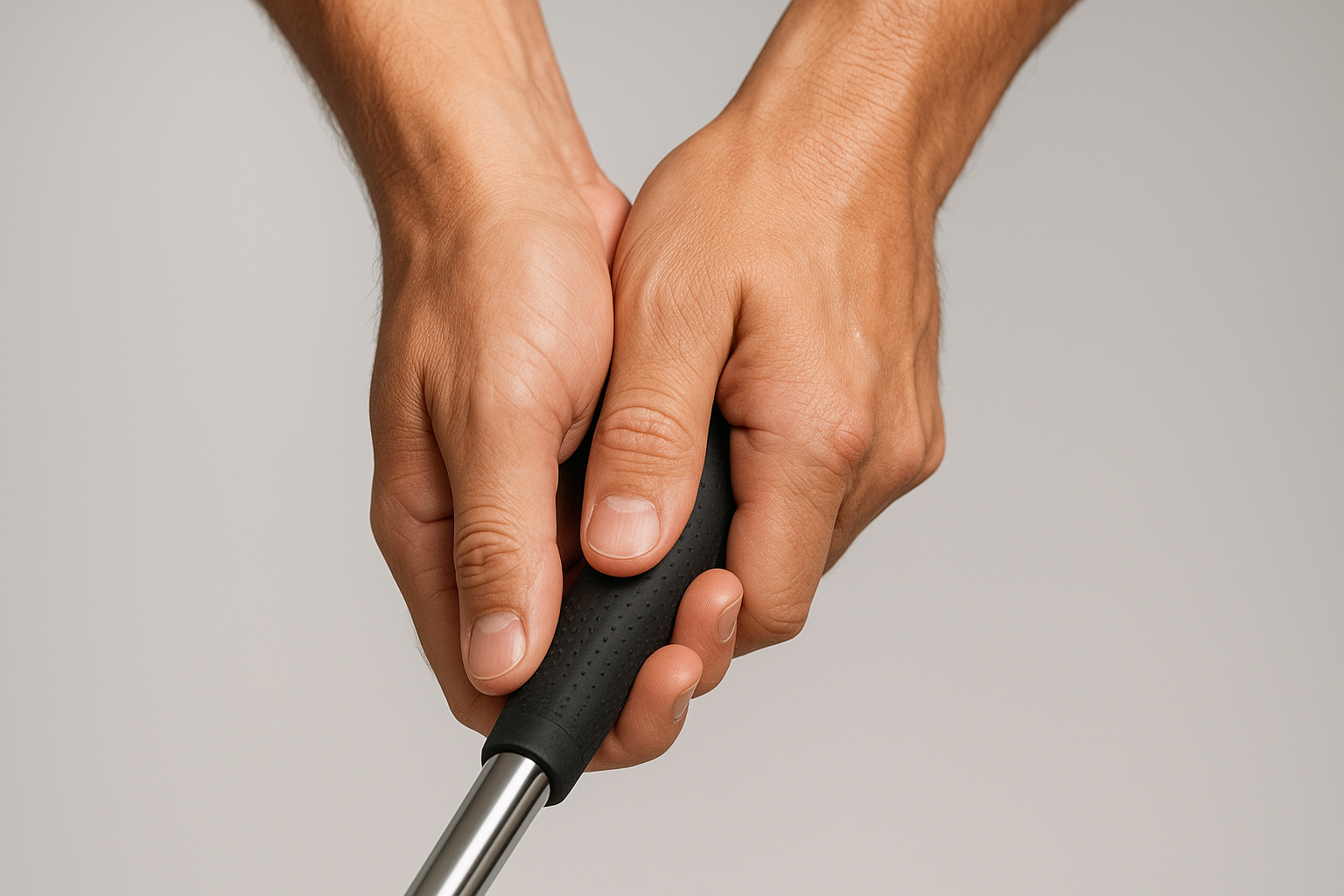
Grip position is one of the earliest checkpoints in golf swing mechanics.
The Biomechanics Behind an Efficient Golf Swing
Biomechanics — the study of forces acting on the body during movement — explains why certain swings hold up under pressure while others break down. Specifically, an efficient swing relies on a proper kinematic sequence: the hips initiate the downswing, followed by the torso, arms, and finally the club. Research referenced by the National Institutes of Health on sports biomechanics suggests that golfers who follow this sequence generate significantly more clubhead speed than those who fire the arms first.
In addition, the muscles involved matter as much as the sequence itself. Overusing the arms and shoulders while underusing the core and glutes is a common pattern that reduces both power and durability. Our detailed article on the main muscles of the golf swing and their misuse explores this in greater depth, including how misuse contributes to overuse injuries over a competitive season.
Notably, studies on amateur swing patterns estimate that up to 80 percent of recreational golfers rely on excessive arm movement rather than proper kinematic sequencing, which can reduce potential clubhead speed by 10 to 15 miles per hour. Therefore, correcting sequencing alone often produces one of the largest single gains in distance available to a golfer.
Step-by-Step Process to Rebuild Your Swing Technique
Rebuilding faulty mechanics works best as a structured process rather than random tinkering. The following steps outline the approach used in data-driven, kinesiology-based coaching programs.
- Record your current swing. Capture face-on and down-the-line video at full speed so an instructor can pinpoint exactly where the motion breaks down.
- Identify the root cause. Work backward from impact to find the earliest fault, since later errors are usually compensations rather than the true problem.
- Isolate the fix with slow-motion drills. Practice the corrected position at reduced speed using mirrors or alignment sticks until it feels repeatable.
- Add speed gradually. Increase tempo only once the new pattern holds consistently, to avoid reverting under pressure.
- Test the change on-course. Validate the new mechanics in real playing conditions, since a swing change must survive competitive pressure to count.
Common Mechanical Faults That Limit Consistency
Even skilled players fall into predictable mechanical traps. An over-the-top downswing path, early extension toward the ball, and casting the club too soon are three of the most common faults observed across skill levels. As a result, these issues typically cause a mix of slices, thin contact, and lost power.
Furthermore, many of these faults develop as compensations for physical limitations rather than pure technique errors, which is why understanding the “why” behind a swing flaw matters. Our page explaining why certain swing faults persist despite lessons covers this connection between physical limitations and technical breakdowns in more detail. For general injury-prevention context, the CDC’s guidance on physical activity also underscores why mobility and strength support safer swing mechanics.
How Kinesiology-Based Coaching Refines Swing Dynamics
Kinesiology-based coaching differs from traditional lessons because it treats the swing as a movement science problem, not just a technical one. Instead of copying a model swing, a kinesiology-trained coach analyzes joint angles, muscle sequencing, and force production to build a plan suited to each golfer’s body.
For competitive and elite players specifically, this approach matters because generic advice often ignores individual mobility restrictions or strength imbalances. Our kinesiology guide to swing dynamics for elite players expands on how this science-backed method is applied remotely, without requiring travel to a physical facility. Ultimately, this remote model — detailed further at yourgolfguru.com — allows serious golfers anywhere to access instruction typically reserved for players near major training centers.

Remote video analysis allows detailed review of golf swing mechanics from anywhere.
Frequently Asked Questions About Golf Swing Mechanics
What is golf swing mechanics?
Golf swing mechanics is the study of the body positions and movement patterns — including grip, stance, rotation, and sequencing — that determine how efficiently a golfer transfers energy into the ball. Understanding these mechanics helps players build a repeatable, powerful, and accurate swing.
How long does it take to improve golf swing mechanics?
Most golfers notice measurable changes within four to eight weeks of focused, guided practice. However, making those changes hold up under competitive pressure often takes several months of consistent repetition.
Why do golf swing mechanics matter for consistency?
Consistent mechanics reduce the number of variables that can go wrong during the swing, which directly improves shot repeatability. Golfers with sound fundamentals also recover from off days faster.
What is the difference between swing mechanics and swing tempo?
Swing mechanics refer to physical positions and sequencing, while tempo refers to rhythm and timing. A golfer can have excellent mechanics but still struggle with inconsistent tempo, and vice versa.
How much does online swing mechanics coaching cost?
Pricing typically ranges from a single video analysis fee to monthly coaching packages with ongoing feedback. Cost usually depends on the coach’s credentials and the depth of biomechanical analysis provided.
What are the most common golf swing mechanics mistakes?
The most frequent faults include an over-the-top downswing path, early extension of the hips, and casting the club too early. These issues typically reduce clubhead speed and cause inconsistent contact.
Can poor swing mechanics cause injury?
Yes, poor mechanics can place excessive stress on the lower back, wrists, and shoulders over time. Correcting mechanical faults early is one of the most effective ways to prevent chronic golf-related injuries.
How does grip affect golf swing mechanics?
Grip directly influences clubface angle at impact, a core component of overall swing mechanics. A grip that is too strong or too weak forces compensations elsewhere in the swing to square the face.
What role does kinesiology play in golf swing mechanics?
Kinesiology helps coaches identify which muscles and joints are underperforming or overcompensating during the swing. This data-driven approach allows for more precise and safer corrections than generic instruction.
How can I check my own swing mechanics at home?
Recording your swing from down-the-line and face-on angles with a smartphone is the simplest self-check method. Comparing your positions at address, top of backswing, and impact against efficient models reveals obvious faults.
Do professional golfers all use the same swing mechanics?
No, professionals show individual style variations, but they share common checkpoints such as proper sequencing and stable spine angle. These shared fundamentals separate elite swings from amateur ones despite visual differences.
What equipment helps analyze golf swing mechanics?
Launch monitors, high-speed cameras, and motion-capture sensors are commonly used for precise analysis. Many online coaches now work from smartphone video alone, paired with expert interpretation, making this accessible remotely.
How often should I practice swing mechanics drills?
Practicing targeted drills two to three times per week, with focused repetitions, tends to produce faster improvement than occasional long sessions. Quality of repetition matters more than total ball count.
Final Thoughts on Building Better Golf Swing Mechanics
Ultimately, improving golf swing mechanics comes down to identifying the true root cause of a fault, correcting it methodically, and testing the change under real pressure. Rather than chasing quick tips, competitive golfers benefit most from a structured, science-backed process grounded in biomechanics and kinesiology.
In summary, sound golf swing mechanics protect against injury, unlock additional power, and create the consistency needed to compete at a higher level. For golfers ready to pursue expert, data-driven coaching remotely, resources like those available through Your Golf Guru offer a science-based path forward built on decades of teaching experience and kinesiology research.