
Steering in golf happens the instant your hands and wrists try to bail out a downswing that has already gone slightly wrong, squaring the clubface at the very last possible moment before impact. It is quietly responsible for more slices, blocks, and maddeningly inconsistent rounds than almost any other single fault in the golf swing. Consequently, understanding exactly why steering happens — and why even the best players in the world do it — is the fastest route to eliminating it from your own game.
This article was sparked by a remarkably candid comment from Mike Schy, the lifelong coach of Bryson DeChambeau. When asked what single movement causes the most inconsistency among golfers of every skill level, he did not hesitate: “Professionals are the greatest steerers of the golf ball on the planet — and they were always told ‘don’t steer.’ Amateurs try to steer but aren’t ready to, because they don’t have the strength or ability yet. So they’re told ‘trust, trust,’ and yet they’re always trying to steer. The pro golfer, when he’s ‘on,’ is the epitome of steering. When he goes away from that — when he’s trying to trust timing instead — that’s when the ball goes everywhere.” In other words, steering is a last-instant effort by the hands to square the face at impact, and whether it helps or hurts you depends entirely on how your body is set up to deliver it.
What Is Steering in Golf, Exactly?
Steering in golf refers to a late, hands-and-wrists manipulation of the clubface during the final split second of the downswing. Rather than the clubface arriving square as a natural consequence of a well-sequenced swing, the golfer actively intervenes to “save” the shot. For amateurs, this usually shows up as a defensive block to the right or a weak slice, because the hands intervene too late and too inconsistently. For elite players, however, steering can — surprisingly — be a repeatable, intentional skill. The difference lies entirely in body mechanics, and specifically in what the trail shoulder, elbow, and wrist are doing when the club reaches the horizontal, parallel-to-ground position on the way down.
Why Professionals Steer the Golf Ball — And Why Amateurs Shouldn’t Try
According to Schy, the best thing an elite golfer can do is simply let the steer happen. That is likely because a highly skilled golfer’s subconscious mind already knows, at a split-second level, exactly what small adjustment will save the shot. This is a well-documented concept in the world of motor control — the branch of neuroscience concerned with how the brain organizes complex human movement. Nikolai Bernstein, one of the founding figures of motor control research, argued that sensory feedback about the effects of a movement plays a substantial role in how the brain fine-tunes complex actions in real time.
In the golf swing, however, feedback about a downswing going off track arrives extremely late — often only a few tenths of a second before impact. As a result, only golfers with thousands of repetitions under their belt have built the pattern recognition needed to act on that feedback in time. That is precisely why only professional and other highly skilled players can attempt — and sometimes succeed at — a last-instant correction that could fairly be called “steering.” Amateurs simply have not banked enough reps for their brain to trust that feedback loop, which is why they’re told to “just trust” the swing instead of manipulating it. If you want to build the kind of repeatable motion that reduces the need for late hand manipulation altogether, it helps to first test the consistency of your own golf backswing before chasing a downswing fix.
The Two-Way Miss: When Steering the Driver Stops Working
Even elite players eventually start to doubt their own steering, and the culprit is usually an unexpected two-way miss — a driver that occasionally goes both left and right with no obvious pattern. In a video discussing recently-explored swing changes (https://www.youtube.com/watch?v=1aeTZTMSZcw), Bryson DeChambeau explained the problem bluntly: “I gotta change something. I can’t go out and win a tournament and go out and miss the cut the next week. I need to be way more repeatable.” He then described trying a position similar to Jordan Spieth’s, in which the lead elbow points toward the target. With his lead shoulder rotated to the maximum of internal rotation — meaning the upper arm turns inward toward the torso — he found it nearly impossible to hit the ball left. This conversation, held with instructor Chris Como, centered on how driving a joint into an “end-range of motion” can create a physical lock that prevents a body segment from overshooting a good position at impact.
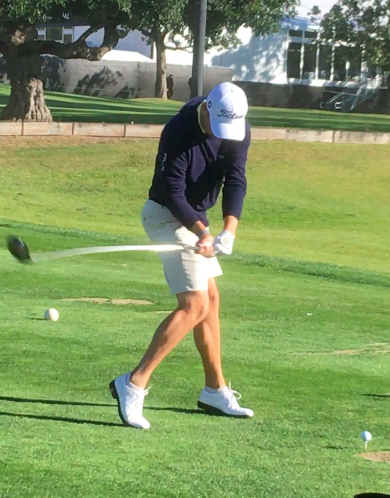
However, this fix has real limitations. Getting the lead shoulder into an end-range of internal rotation is not always achievable, since it requires very specific, simultaneous positions of the trail arm and torso. Furthermore, pushing a joint to its end range is a recognized injury risk. There are also far simpler “locks” available than one that interferes with the already complex coordination of two hands joined together on the grip. Most importantly, the real root cause of the two-way miss — the one many tour professionals experience without ever understanding why — lies elsewhere entirely: in the position of the trail shoulder, elbow, and wrist when the club reaches parallel to the ground on the downswing (see page 72 of https://en.calameo.com/read/004756792786810f37cc8, pictured below).
The Real Biomechanical Cause of Steering in Golf
Because professionals generate an extremely rapid pelvic rotation toward the target, and because the shoulders are strongly coupled to pelvic rotation in skilled golfers — a relationship confirmed by biomechanics research — the shoulders rotate open right along with the hips. This chain reaction pushes the trail shoulder into protraction (a forward bending motion) combined with internal rotation. That combination creates a genuine problem for the trail elbow, since the elbow extends most efficiently when the shoulder is slightly externally rotated instead. As a result, trail elbow extension becomes awkward and inefficient, leaving the wrists and hands to “fend for themselves” in the final moments before impact.
That scramble is the true cause of steering in golf: the golfer’s hands attempting a very late correction to square the clubface, and not always succeeding. In fact, this suggests that an effective steer is less the opposite of good timing and more a byproduct of it — everything depends on how freely the trail elbow can straighten. Under pressure, when the arm and forearm muscles tense up, this last-instant correction becomes even less reliable, which explains why steering tends to fall apart precisely when the stakes are highest.
How Pelvic Rotation Triggers a Late Steering Reflex
In practical terms, the faster and more aggressively the hips clear toward the target, the more the shoulders — and therefore the trail arm — get dragged into an unfavorable position. Above all, this is why simply telling a golfer to “turn faster” or “trust the swing” often backfires: a faster pelvic rotation without the correct trail-shoulder sequencing only makes the steering reflex more necessary, not less. In contrast, golfers who understand how to hit the ball further, straighter, and higher every time typically do so by improving sequencing first, and adding speed second — never the other way around. You can review that exact sequencing approach in our guide on how to hit the ball further, straighter, and higher every time.
The Fix: How to Stop Steering in Golf and Swing on Plane
Only one swing model directly prevents the early protraction and internal rotation of the trail shoulder described above: the Minimalist Golf Swing (MGS). By keeping the trail shoulder from rotating internally too early, this model positions the trail elbow so it can extend while the shoulder remains more externally rotated — exactly the condition the elbow needs to straighten efficiently. As a result, the wrists are freed up to do their job during the downswing instead of scrambling to compensate at the last instant.
While this alone will not “fix” every golfer overnight, there is a simple visual checkpoint you can use to see whether your trail arm is in a better position. When the club shaft is horizontal on the downswing, check the angle of your trail forearm relative to your torso. If it sits at roughly 90 degrees, or perpendicular, to your torso, your trail shoulder is likely protracted and internally rotated too early — the exact pattern that forces a last-second steer. If instead it sits closer to 45 degrees to your torso, your trail shoulder is in a far more favorable position, and your elbow will extend far more naturally through impact.
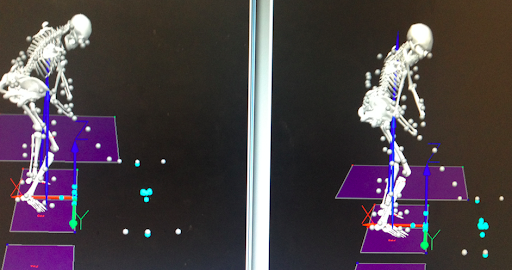
Left: trail forearm near 90° to the torso (steering-prone). Right: trail forearm near 45° to the torso (MGS position).
Keep in mind that several factors have to line up correctly to achieve a good trail shoulder position, so a single quick-fix downswing thought is rarely enough on its own. A genuine facsimile of the MGS pattern is currently the only reliable way to prevent a last-minute, timing-dependent steer on a consistent basis — rather than hoping your timing shows up on the day it matters most.
Step-by-Step: How to Stop Steering in Golf
Use the sequence below to work through the fix methodically rather than guessing at swing feels:
- Film your downswing from behind the ball so you can pause the video precisely when the club shaft is parallel to the ground, and note the visible angle between your trail forearm and your torso at that exact moment.
- Compare your forearm angle to the 45-degree checkpoint described above, since a forearm sitting closer to 90 degrees signals early trail shoulder protraction that forces a late, unreliable steer at impact.
- Slow your transition down deliberately so your pelvis does not fire so aggressively that it drags your trail shoulder into internal rotation before your arms are ready to deliver the club.
- Rehearse the trail elbow extension in isolation using half-speed swings, feeling the elbow straighten while the shoulder stays slightly externally rotated rather than jammed forward.
- Take one single swing thought to the range or course at a time, checking your forearm angle every ten balls so you can confirm the change is holding under normal swing speed.
Simple Drills to Feel the Difference Between Steering and Releasing
Beyond the video-and-checkpoint method above, a handful of feel-based drills can help you recognize steering in golf the moment it happens on the course, not just on video:
- The headcover-under-the-arm drill: Tuck a headcover lightly under your trail armpit during half-speed swings. If it drops early in the downswing, your trail shoulder is protracting too soon, setting up the exact fault described above.
- The pause-at-parallel drill: Swing to the position where the shaft is parallel to the ground on the downswing, stop, and check your forearm-to-torso angle in a mirror before continuing through impact.
- The soft-hands checkpoint: Grip pressure that spikes in the last few feet of the downswing is a reliable tell that your hands are steering rather than releasing freely through the ball.
- The one-swing-thought rule: Never rehearse more than one physical change per range session; stacking multiple cues is a common reason golfers revert to steering under pressure.
If you have worked through these drills honestly and still can’t identify what your trail shoulder is doing on video, it may be time to consider whether it’s time to take a golf lesson with a coach who can check your positions in person. Similarly, if you suspect a related fault is compounding the problem, it’s worth reviewing one of the most idiotic positions in the golf swing, since the two faults frequently show up together.
Frequently Asked Questions About Steering in Golf
What is steering in golf?
Steering in golf is a last-instant attempt by the hands and wrists to square the clubface right before impact, rather than letting the clubface arrive square as a natural result of a well-sequenced swing. It is the primary cause of blocks, slices, and unpredictable misses for most golfers.
Why do professional golfers steer the ball on purpose?
Elite golfers have banked thousands of repetitions, which allows their subconscious mind to interpret late feedback about the downswing and make a genuinely useful, split-second correction. Amateurs typically lack the repetitions needed for that feedback loop to work reliably, which is why steering hurts amateurs far more than it helps them.
What causes the “two-way miss” many golfers experience?
The two-way miss happens when the trail shoulder rotates open too early alongside a fast pelvic turn, forcing the trail elbow into an awkward extension pattern. Because the resulting hand correction is timing-dependent, the miss can go either direction depending on how late or early the steer arrives.
How does trail shoulder position cause steering in golf?
When the trail shoulder protracts and internally rotates too early in the downswing, the trail elbow cannot extend efficiently. This leaves the wrists to compensate on their own in the final moments before impact, and that compensation is what golfers and coaches describe as “steering.”
Can you completely stop steering in golf?
Yes, but it requires addressing the trail shoulder position directly rather than relying on a single swing thought. Correcting the sequencing so the forearm sits near 45 degrees to the torso at the parallel position, instead of near 90 degrees, removes the need for a late hand correction almost entirely.
What drills help you stop steering in golf?
The headcover-under-the-arm drill, the pause-at-parallel checkpoint, and monitoring grip pressure spikes are three of the most reliable ways to feel the difference between steering and a natural release. Working through them on video, one change at a time, produces the most lasting results.
Final Thoughts: Stop Steering, Start Trusting a Better Sequence
In summary, steering in golf is not simply a bad habit to be willed away with vague advice like “just trust it.” Instead, it is a predictable mechanical response to what the trail shoulder, elbow, and wrist are doing at the moment the club reaches parallel on the downswing. Professionals can get away with steering because years of repetition let their subconscious react to late feedback; amateurs generally cannot, which is exactly why the advice to “stop steering” rings hollow without a mechanical fix behind it. Therefore, rather than chasing a feeling, check your forearm-to-torso angle on video, work through the drills above, and build a sequence — such as the Minimalist Golf Swing pattern described here — that removes the need for a last-second correction altogether. Do that, and steering in golf stops being a mystery you fight every round and becomes a non-issue you rarely think about again.