
A good golf swing is not a matter of talent, hours on the range, or a dozen swing thoughts crammed into one motion — it is a product of anatomy, sequencing, and a handful of repeatable positions. Whether you are a weekend player chasing more distance or a low-handicapper hunting consistency, you have probably wondered what a truly great golf swing looks like, why your own swing breaks down under pressure, and what separates a tour-quality move from an amateur lunge. This guide answers all of it — not with vague swing thoughts, but with real biomechanics, common faults, and fixes that actually work.
Unlike most instructional articles, we will not stop at describing positions. We will explain why your body moves the way it does during a golf swing, what the science of joints and muscles dictates, and how that knowledge explains the single most common fault in golf — swinging “over the top.” By the end, you will understand your golf swing better than most instructors explain it, and you will know exactly what to work on next.
What Does a Good Golf Swing Actually Look Like?
Before diving into anatomy, let’s answer the question plainly. A good golf swing shares a handful of visible traits regardless of the player’s size, flexibility, or swing style. You will see these checkpoints in almost every elite ball-striker, from classic swingers to modern “stack and tilt” players:
- Athletic setup: knees slightly flexed, spine tilted from the hips, arms hanging naturally under the shoulders.
- Connected takeaway: the club, arms, and torso move together for the first two feet of the backswing.
- Coil against resistance: the shoulders turn further than the hips, storing rotational energy.
- Lower-body-first transition: the downswing begins with the pelvis and feet, not the hands or shoulders.
- Shallow, inside approach: the club drops behind the body before swinging forward to the ball.
- Flush, compressed impact: hands ahead of the clubhead, hips open, chest still slightly behind the ball.
- Balanced finish: full extension through the ball followed by a tall, stable finish position.
Those checkpoints describe what a good golf swing looks like. However, almost no instructional content explains why so few golfers — even professionals — actually achieve that “shallow, inside approach” checkpoint consistently. That answer lies in anatomy, and it is where this guide goes further than most.
The Anatomy Behind Every Golf Swing
To understand your golf swing, you first need a little basic anatomy. A joint is the place where two bones meet. The bones never actually touch — they are connected through a joint capsule — and movement happens because muscles attached on either side of the joint pull the bones closer together or push them further apart. Every rotation, bend, and extension in your golf swing comes down to this simple mechanical rule.
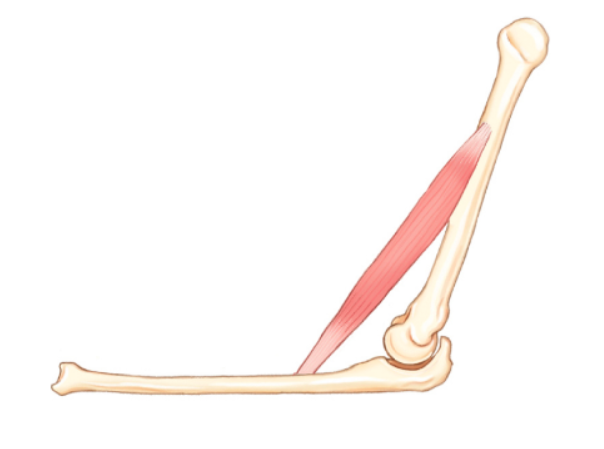
Joints move because muscles on either side pull bones closer together or push them apart — the foundation of every golf swing position.
Why Two-Joint Muscles Limit What Your Body Can Do
Some muscles are long enough to cross two, or even three, joints at once. In theory, that means one muscle could move several joints simultaneously. In practice, research in kinesiology — the scientific study of human movement — shows that two-joint muscles cannot work maximally at both ends at the same time. This limitation is called active insufficiency.
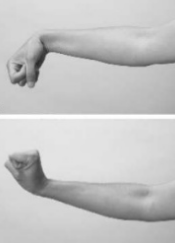
Make a tight fist, then bend your wrist forward — notice how your grip loosens. That is active insufficiency, and it quietly shapes your golf swing.
Try it yourself: make a tight fist, then bend your wrist backward — your grip stays firm. Now bend your wrist forward toward your palm, and your fingers loosen slightly. The muscles that flex both the fingers and the wrist cannot be maximally efficient at both joints simultaneously. This single anatomical fact, largely ignored by mainstream golf instruction, explains much of what goes wrong — and right — in the golf swing. If you want the complete biomechanical breakdown of these movements, our scientific analysis of golf swing moves expands on exactly how each joint contributes to the kinetic chain.
What the Golf Downswing Must Actually Achieve
Regardless of what a golfer does on the way down, the ball does not care about technique, anatomy, or style. For a shot to fly high, straight, and far, the club must arrive at the ball from an inside path, with an appropriate angle of attack, at maximum speed. That is the entire job description. As Wikipedia’s overview of the golf swing confirms, clubhead path and speed at impact — not how pretty the swing looks — determine ball flight.
Therefore, if the club must be delivered from the inside, the arms and trail shoulder (the right shoulder for a right-handed golfer) must also arrive from the inside — behind and below the lead shoulder, elbow, and wrist. This is where theory and practice diverge for almost every golfer on earth, including tour professionals.
Why Most Golf Swings Go “Over the Top”
Most golf swings, viewed from an anatomical perspective, are “over the top” (OTT) — meaning they are not arriving from the inside. This includes the vast majority of recreational golfers and even many elite players. You can spot it when, at impact, the trail shoulder sits forward of the trail toe, the trail thigh points forward and down, or the trail elbow trails behind the shoulder when a vertical line drops from it.
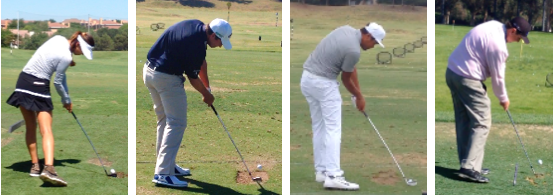
Every golfer pictured here is a PGA or LPGA Tour player — and every one shows some degree of an over-the-top golf swing position.
OTT happens for two different reasons depending on skill level. Less skilled golfers start the downswing with a predominantly downward motion rather than a rotational one. More skilled golfers, on the other hand, rotate the pelvis so early and so fast during the downswing that the trail thigh and shoulder get pulled down and forward anyway — too much, too soon. Either way, the result looks similar at impact, even if the cause is different.
The Top-of-Backswing Position That Triggers Over-the-Top
So what, specifically, causes the trail side to lunge downward and forward? Look at the top of the backswing. Almost every golfer raises the trail shoulder higher than it sits at address or impact, and the trail arm moves away from the body. This stretches powerful shoulder and trunk muscles, priming them to contract more forcefully — and because they were stretched upward, they will also contract downward.

The same players at the top of the backswing — notice the raised trail shoulder that sets up the downward pull you saw at impact.
The Key Muscles Controlling Your Swing Mechanics
Two muscle groups do most of the heavy lifting — and most of the damage — in a flawed golf swing: the latissimus dorsi and the external oblique.
The Latissimus Dorsi: Your Trail Arm’s Brake and Accelerator
The latissimus dorsi — the broad “lat” muscle of the back — moves the trail upper arm away from the body during the backswing. It is a two-joint muscle, connecting at the spine and at the upper arm, which means its behavior at one end always affects the other.
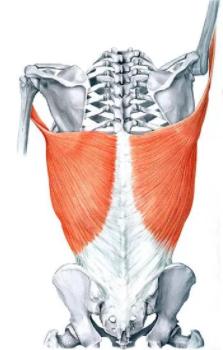
The latissimus dorsi pulls the trail arm toward the body — the direction and timing of that pull shapes your entire downswing.
The External Oblique: Rotator or Downward Puller?
The external oblique muscle of the torso can either rotate the trunk or drop it downward, depending entirely on the direction it was stretched during the backswing. Stretch it upward, and it pulls the torso down. Stretch it horizontally, and it rotates the torso instead — a distinction that explains why some golfers rotate beautifully through impact while others collapse downward.
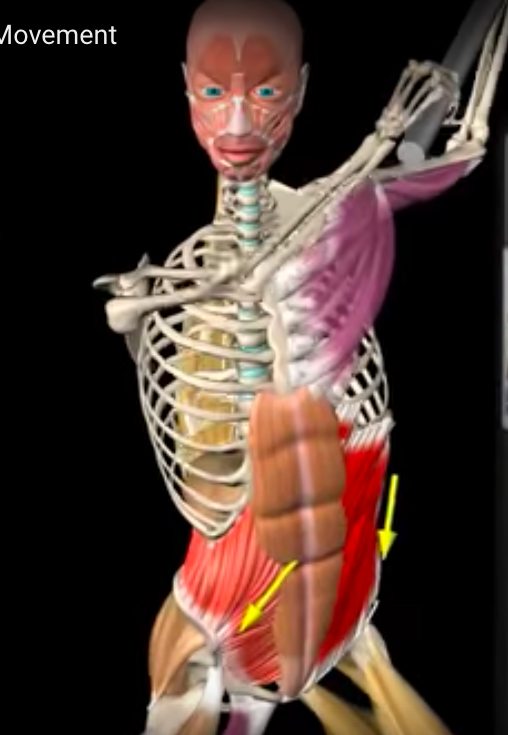
External oblique fiber direction determines whether your torso rotates smoothly or drops straight down in the downswing.
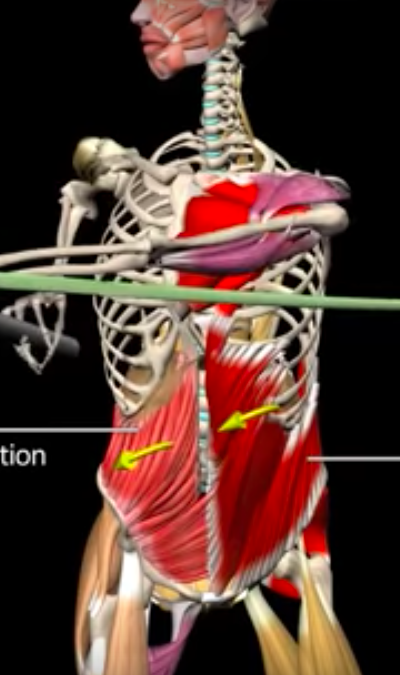
A closer view of the same external oblique fibers — the muscle architecture behind every rotational downswing.
Because all torso muscles are interconnected, pelvis rotation early in the downswing inevitably pulls the upper trunk down and forward too. In other words, as long as the trail shoulder sits high and the trail arm rises at the top of the backswing, some degree of over-the-top motion is almost unavoidable — a race against time that even skilled golfers fight on every swing.
The Minimalist Golf Swing “Magic Move”
The Minimalist Golf Swing (MGS) approach solves this problem with one adjustment: keeping the trail shoulder and trunk lower than the lead shoulder throughout the backswing, rather than letting it rise. This stretches the trail-side external oblique horizontally instead of upward, so the muscle rotates the trunk rather than yanking it downward.
What about the lats? Because this position keeps the spine in side bend, it keeps the latissimus dorsi active at the spinal attachment, which limits how much it stretches at the upper arm attachment. As a result, the lats do not aggressively yank the trail arm toward the body while the external oblique is simultaneously trying to move the torso. The two muscles stop fighting each other.
Imagine a golf swing with no need to consciously think about ground-up sequencing, because the pelvis cannot rotate too early in the first place. Imagine controlling divot depth simply by hand height, or swing plane simply by how closed the shoulders are at address — no steep-to-shallow compensations required. That is the practical goal of positioning the body correctly at the top: every joint can unbend in its most natural sequence, without a single conscious swing thought.
Ball Flight Laws, Launch Monitors, and Swing Path for Irons vs. Driver
Modern launch monitors have taught golfers that a straight shot requires matching swing path to angle of attack: a slightly steeper, descending strike for irons pairs best with an out-to-in path, while the ascending strike needed for a driver pairs best with an in-to-out path. Common advice — adjusting ball position, or using specific trunk side-bend angles at address — treats the symptom, not the cause.
As we have shown, it is the direction in which the core muscles are stretched at the top of the backswing that determines how the body, arms, and club actually move on the way down. Consequently, preparatory setup tweaks are largely cosmetic unless the backswing position itself changes.
Additionally, the modern swing — and most of its popular variants — is a narrow, compact movement with little room to reroute the arms into a truly inside approach. As a result, an out-to-in path at impact has become “par for the course.” This works reasonably well for irons, even if it also digs unnecessarily deep, injury-prone divots. For the driver, however, even tour pros retain some out-to-in bias, which is why driver accuracy remains inconsistent at every level — their lats and external obliques simply will not let go. A golfer with a long, loose arm swing can sometimes drop the club into the slot anyway, but that depends on timing, and research consistently shows timing degrades under pressure.
How to Build a Repeatable Golf Swing: Step-by-Step
Knowing the anatomy is only half the battle. Here is a practical, sequential process for grooving a golf swing that repeats under pressure, rather than one you have to consciously steer.
- Set up athletically with the trail side slightly lower. Flex your knees, tilt from the hips, and let your trail shoulder sit a touch lower than your lead shoulder at address so the backswing starts from the correct relationship rather than fighting it later.
- Turn your shoulders and arms together without raising the trail shoulder. Keep the trail shoulder and trunk low throughout the turn instead of letting the shoulder climb, which keeps the external oblique stretched horizontally rather than upward.
- Start the downswing with the feet and pelvis, not the arms or shoulders. Push into the ground and let the lower body initiate rotation, allowing the upper body and club to follow naturally instead of casting from the top.
- Let the club shallow out automatically instead of forcing it. Because the trail-side muscles were never over-stretched upward, the arms and club will drop into an inside path without any conscious steepening or shallowing moves.
- Deliver the club from the inside with hands leading the clubhead. Arrive at impact with the trail shoulder behind and below the lead shoulder, hands ahead of the ball, and hips already rotating open toward the target.
- Extend fully and finish balanced on your lead leg. Let the arms extend down the target line after impact and rotate all the way into a tall, stable finish position with your weight fully transferred forward.
For a deeper breakdown of how ground force and weight transfer specifically fit into step three, see our dedicated article on weight shift and ground reaction force in the golf swing, which explains how pushing through the feet — rather than jumping or bouncing — generates speed far more reliably.
Common Golf Swing Faults and How to Fix Them
Most swing faults trace back to the same root cause discussed above — but they show up differently depending on the golfer. Here are the most common ones, and what actually fixes them:
- Over-the-top (slice or pull): caused by a raised trail shoulder at the top. Fix it by keeping the trail shoulder low throughout the backswing instead of trying to “drop the club in the slot” with a conscious move.
- Early extension: the hips thrust toward the ball in the downswing, usually to compensate for an arm-dominated start. Fix it by initiating the downswing with rotation, not a downward heave.
- Casting (early release): the wrists unhinge too soon, bleeding speed before impact. Fix it by letting the lower body lead so the arms and club lag naturally.
- Reverse pivot: weight stays on the lead foot during the backswing and shifts to the trail foot during the downswing — the exact opposite of a proper weight shift. Fix it by feeling pressure build into the trail foot going back and into the lead foot coming down.
- Sway instead of turn: the hips slide laterally rather than rotating. Fix it by turning against a stable trail leg rather than sliding away from the ball.
If your miss changes from round to round, inconsistency — not a single swing flaw — is likely the real issue. Our guide on improving golf swing consistency in five key steps walks through the practice framework that turns a good range swing into a reliable on-course swing.
Drills to Groove an Inside-Out Swing Path
Understanding the anatomy is valuable, but drills translate that understanding into feel. Try these:
- Headcover gate drill: place a headcover just outside the ball on the target line. An over-the-top path clips it; an inside path misses it cleanly.
- Low trail-shoulder drill: make slow-motion backswings in front of a mirror, focusing only on keeping the trail shoulder from rising above its address height.
- Step-through drill: swing while stepping toward the target with your trail foot right after impact. This exaggerates lower-body-first sequencing and discourages an arm-dominated downswing.
- Pump drill: rehearse the transition by pumping the club halfway down two or three times before swinging through, reinforcing the feeling of the lower body leading.
How Swing Consistency, Ground Force, and Distance Connect
A sound golf swing is not only about accuracy — it is also the foundation of distance. Once the club consistently arrives from the inside with speed, extra yardage tends to follow naturally, without any added effort or injury risk. Our resource on how to hit the ball further, straighter, and higher every time builds directly on the mechanics covered here, showing how sequencing and anatomy combine to add distance without sacrificing control.
If you have worked through the drills above and still cannot identify what is holding your swing back, a personalized evaluation is often the fastest route forward. Our golf swing diagnostics service offers elite-level analysis for serious players who want a precise, individualized breakdown rather than generic tips.
Frequently Asked Questions About the Golf Swing
What does a good golf swing actually look like?
A good golf swing starts from an athletic setup, uses a connected takeaway, coils the shoulders against resisting hips, starts the downswing from the ground up, delivers the club from an inside path at impact, and finishes in a tall, balanced position. The exact look varies between players, but these checkpoints stay consistent across every elite swing.
What is the most important part of the golf swing?
The top-of-backswing position is arguably the most important, because it determines the direction the trail-side muscles are stretched. That, in turn, dictates whether the downswing rotates efficiently or drags the body down and forward into an over-the-top path.
Why do so many golfers swing over the top?
Most golfers raise the trail shoulder at the top of the backswing, which stretches the latissimus dorsi and external oblique muscles upward instead of horizontally. Those muscles then contract downward during the transition, pulling the trail side forward and down rather than allowing clean rotation.
Can anatomy really affect my golf swing?
Yes. Muscles that cross two joints, like the latissimus dorsi and external oblique, cannot contract maximally at both ends simultaneously — a limitation called active insufficiency. The direction those muscles are stretched during the backswing directly shapes how the body moves during the downswing, regardless of how hard you try to consciously control it.
How long does it take to fix an over-the-top golf swing?
Most golfers notice a change within a few focused practice sessions once they stop raising the trail shoulder at the top, since this removes the root cause rather than masking the symptom. Full consistency under on-course pressure typically takes several weeks of deliberate repetition.
What muscles matter most in the golf swing?
The latissimus dorsi and external oblique muscles matter most, since they control how the trail arm and torso behave during the transition from backswing to downswing. Their stretch direction at the top of the backswing determines whether the downswing rotates cleanly or collapses downward.
Conclusion: Building a Golf Swing That Repeats Under Pressure
A great golf swing is not built on willpower or a long list of swing thoughts — it is built on understanding how your joints and muscles actually work together. Once you recognize that a raised trail shoulder at the top of the backswing sets off a chain reaction that pulls the body over the top, you can address the real cause instead of chasing symptoms forever. Keep the trail side low, let the lower body lead the downswing, and allow the club to arrive from the inside the way your anatomy intends. Master that sequence, and your golf swing will stop needing constant conscious correction — it will simply repeat, round after round, under pressure and without one.