


Collegiate golf training programs are structured plans that combine swing coaching, short-game work, strength and conditioning, and recovery to help college players lower their scores. The best ones balance hard practice with the rest a student-athlete needs. This guide shows what a strong program includes and how to build one around your schedule.
Quick answer: An effective college golf program has four parts: technical swing work, short-game and course practice, golf-specific strength training, and planned recovery. Measure results every four to six weeks and adjust.
What Are Collegiate Golf Training Programs?
They are year-round plans built for players who compete at the NCAA, NAIA, or junior college level. Unlike casual practice, they link every session to a measurable goal. As a result, players know why they are on the range, in the gym, or on the putting green.
Most programs cover the competitive calendar, including fall and spring seasons, qualifying, and off-season development. For rules on athlete time demands, see the NCAA.
Core Components of a College Golf Training Plan
Technical Swing Work
Swing mechanics drive power, accuracy, and consistency. Therefore, a good plan uses video and data to find inefficiencies rather than chasing a “perfect” look. Biomechanical analysis also shows which movements stress the back, hips, or wrists.
Short Game and Course Management
Scoring happens within 100 yards. Consequently, wedge distance control, bunker play, and putting deserve a large share of practice time. Pair this with on-course simulations, such as playing nine holes with only one ball and no mulligans.
Strength, Mobility, and Recovery
Golf-specific fitness builds rotational power and protects joints. In particular, focus on hip mobility, thoracic rotation, single-leg stability, and core strength. Our guide to online golf fitness programs for elite players goes deeper on this.

A college golfer works on iron play during an early practice session.
How to Build a College Golf Training Week
Follow these steps to create a balanced plan.
- Audit your game. Review your last ten rounds and find the two weakest areas.
- Set measurable targets. Choose goals for clubhead speed, dispersion, and short-game proximity.
- Schedule training blocks. Spread technical, strength, and on-course sessions so hard days are separated.
- Add recovery and mobility. Include sleep goals, mobility work, and one full rest day.
- Review and adjust. Retest monthly and update the plan before tournament season.
Sample Weekly Structure
| Day | Focus |
|---|---|
| Monday | Technical swing session and lower-body strength |
| Tuesday | Short game and putting |
| Wednesday | On-course play or simulated rounds |
| Thursday | Upper-body strength, rotational power, mobility |
| Friday | Light ball striking and wedge distance control |
| Saturday | Tournament or competitive round |
| Sunday | Rest and recovery |
Adjust this to match class times and team practice. For more detail, read our complete guide to online golf training for collegiate golfers.
Injury Prevention for College Golfers
Repetitive swings place load on the lower back, wrists, and shoulders. However, most overuse problems build slowly. Track weekly ball counts, warm up before every session, and report pain early.
Kinesiology-based analysis helps here. It identifies movement patterns that raise injury risk, then replaces them with safer, more efficient mechanics. For general physical activity guidance, the CDC physical activity basics page is a useful starting point.
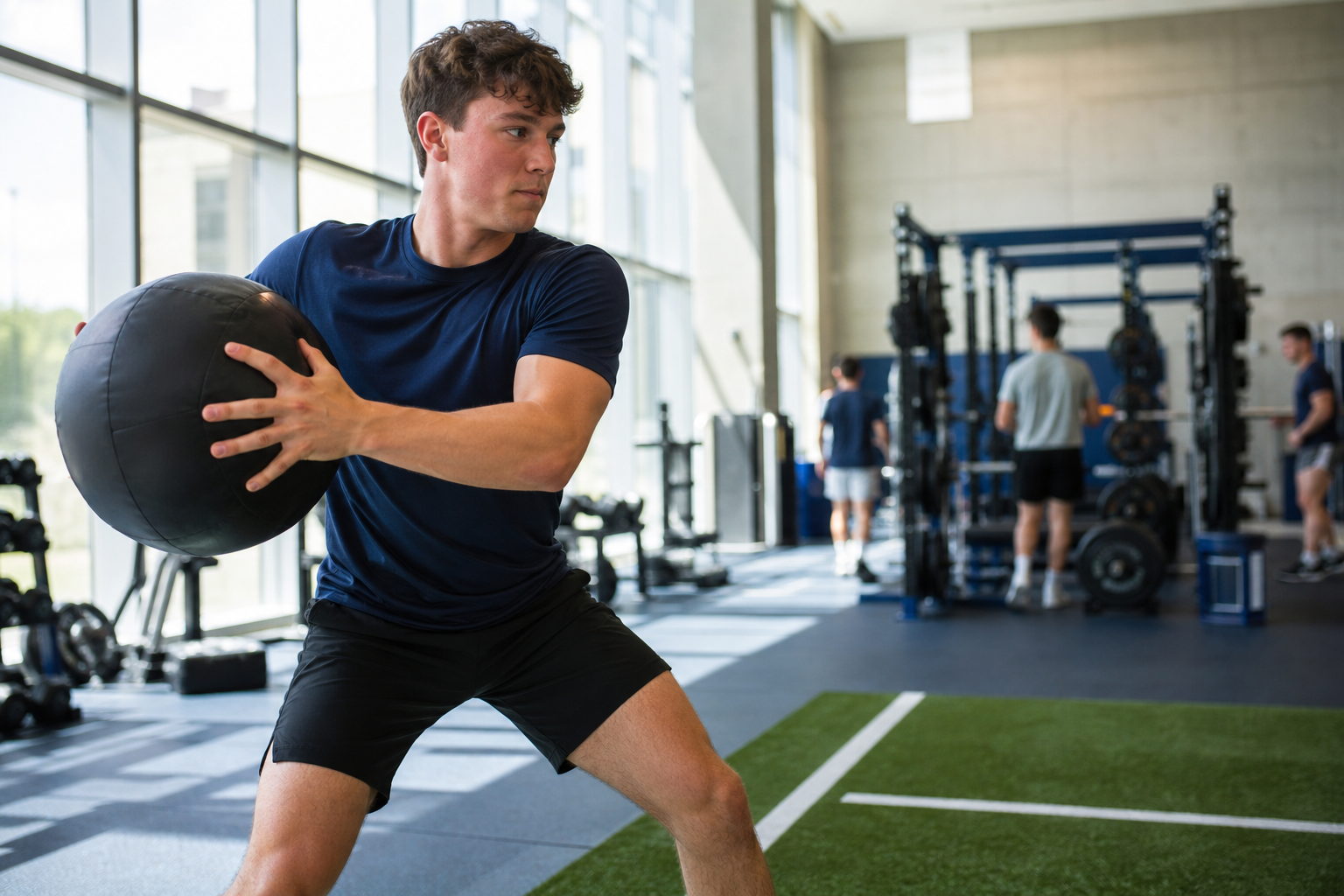
Rotational power drills build speed while protecting the body.
Adding Online Coaching to a College Program
Team coaches often manage a full roster, so individual attention is limited. Online instruction fills that gap. Players upload video, receive detailed feedback, and refine mechanics on their own schedule.
yourgolfguru.com offers online instruction for competitive and collegiate players. Lessons come from an LPGA Master Professional who also holds a PhD in kinesiology, so swing changes are tied to biomechanics and injury prevention. You can explore related resources on competitive golf training programs and effective programs for serious players.
Players who compete outside school golf may also find our page on competitive amateur golf coaching helpful.
Common Mistakes to Avoid
- Hitting large buckets of balls without a target or goal.
- Skipping strength work during the season.
- Making major swing changes right before tournaments.
- Ignoring sleep and nutrition.
- Failing to track results.
Frequently Asked Questions
What are collegiate golf training programs?
Collegiate golf training programs are structured plans that combine swing coaching, short-game practice, strength and conditioning, and recovery for college-level players. They aim to improve scoring while keeping athletes healthy.
How many hours per week do college golfers train?
Many college golfers spend roughly 15 to 20 hours a week on golf-related work in season, though this varies by team and school. NCAA rules limit required athletic activity, so quality matters more than volume.
Can online coaching support a collegiate golf training program?
Yes. Online coaching lets a player upload swing video, review biomechanics, and get feedback from anywhere. It works well alongside team practice.
What should a college golf strength program include?
It should include rotational power, single-leg stability, posterior chain strength, and mobility for the hips and thoracic spine. Progress the load gradually.
How do I prevent injuries during a heavy practice schedule?
Manage workload, warm up properly, and build strength in the core, hips, and shoulders. Address pain early rather than playing through it.
How is college golf training different from junior golf training?
College training has more tournament travel, a heavier academic load, and higher performance expectations. Planning for recovery and time management becomes critical.
How early should I start preparing for college golf?
Start at least one to two years before enrolling. Build physical fitness, tournament experience, and a repeatable swing that holds up under pressure.
Should I change my swing before college?
Only if your swing limits performance or creates injury risk. Major changes are best made in the off-season with a qualified coach.
How do I balance golf training with academics?
Plan your week in advance, protect sleep, and put focused practice ahead of long, unfocused range sessions. Short, purposeful sessions often beat long ones.
What is the biggest mistake in college golf training?
Doing too much without recovery or measurement is the most common mistake. Without tracking, it is hard to know whether practice is working.
How do I measure progress in a training program?
Track clubhead speed, dispersion, putting makes, scoring average, and strokes gained. Retest every four to six weeks.
Do I need a launch monitor?
It is not required, but a launch monitor gives objective data on speed, spin, and carry distance. Video and on-course stats can still guide a good plan.
Conclusion
Strong collegiate golf training programs blend swing mechanics, short-game practice, golf-specific strength, and planned recovery. Set measurable targets, retest often, and protect your body so you can perform across a long season. To add expert, science-based instruction to your plan, visit yourgolfguru.com and start building your next training block.