


Online golf swing consistency drills are the fastest way for competitive players to stop guessing and start repeating a reliable, powerful motion under pressure. Rather than chasing a different swing tip every week, these drills use structured video feedback and biomechanically sound checkpoints to train one repeatable pattern at a time. Consequently, golfers who train this way tend to tighten their shot dispersion faster than those relying on scattered range sessions. This article breaks down exactly how that process works, why it holds up on the course, and which drills deliver the most consistent results when practiced remotely.

Consistent reps at the range reinforce the same checkpoints learned through online golf swing consistency drills.
What Are Online Golf Swing Consistency Drills?
Online golf swing consistency drills are video-guided practice exercises that help a golfer repeat the same mechanical sequence on every swing, using remote coaching feedback instead of in-person instruction.
Specifically, these drills break the swing into measurable checkpoints, such as hip rotation at the top or clubface angle at impact, and then isolate one checkpoint for focused repetition. As a result, players aren’t left guessing whether a drill is actually transferring to real shots. In addition, because the entire process happens on camera, a coach can review footage frame by frame and pinpoint exactly where a pattern breaks down.
For competitive amateurs, collegiate athletes, and aspiring professionals, this approach matters because small timing errors cost strokes that generic lessons rarely catch. Therefore, structured online training has become a practical substitute for golfers who can’t regularly access a specialized instructor in person.
Why Golf Swing Repeatability Breaks Down Under Pressure
Even technically sound golfers often watch their swing repeatability fall apart during competition. This happens because pressure increases muscle tension and speeds up tempo, pulling the body away from trained movement patterns. Consequently, a swing that looked smooth on the range can turn rushed and disjointed on the first tee.
According to USGA handicap data, the average male golfer carries roughly a 14 handicap, a number that reflects shot-to-shot inconsistency far more than a lack of raw power or distance. In other words, most strokes are lost not to weak technique but to unpredictable technique. Above all, this is precisely the gap that structured consistency training aims to close.
Similarly, fatigue late in a round produces the same breakdown as nerves. Without a deeply ingrained pattern, the nervous system defaults to whatever movement feels easiest under stress, which is rarely the mechanically correct one. For that reason, drills must be practiced to the point of automatic recall, not simply understood intellectually.
The Kinesiology Behind a Repeatable Golf Swing
Kinesiology, the scientific study of human movement, explains why some drills produce lasting change while others fade after a single session. Because the golf swing is a complex sequence of joint rotations happening in under two seconds, even small timing errors in the hips or shoulders cascade into large inconsistencies at impact.
As detailed on Wikipedia’s overview of the golf swing, the motion relies on a coordinated kinetic chain from the ground up. Meanwhile, research summarized in the field of motor learning shows that shorter, more frequent practice sessions tend to build durable motor patterns more reliably than long, infrequent ones. Specifically, this is why effective online programs schedule brief, focused blocks rather than marathon range sessions.
A kinesiology-based coach applies this science directly, identifying which joint sequence is firing out of order and prescribing a drill that isolates it. For a deeper look at this method in action, this breakdown of scientific golf swing moves walks through several biomechanical checkpoints used in elite coaching.

Alignment sticks are a simple tool used across most online golf swing consistency drills.
A Step-by-Step Online Training Plan for Consistent Ball-Striking
Building consistent ball-striking from home works best as a structured sequence rather than a random mix of tips. The following process reflects how most kinesiology-based online coaching programs guide players from diagnosis to competitive-ready repetition.
- Record a baseline swing from face-on and down-the-line angles using a tripod so an instructor can identify the specific faults limiting your consistency before any drill work begins.
- Work with a qualified coach to isolate the single biggest mechanical breakdown, such as early extension or an unstable base, rather than trying to fix everything in the swing at once.
- Rehearse the corrected position at a slow, controlled tempo using mirror work or video feedback until the new movement pattern feels natural without a club in hand.
- Introduce the checkpoint into half-speed swings with a club, checking impact position frequently with alignment sticks or impact tape to confirm the new pattern is transferring correctly.
- Once the half-speed pattern holds steady, build full-speed repetition blocks of ten to fifteen swings, resting briefly between sets to keep focus sharp and avoid fatigue-based compensations.
- Finish each session with a scoring game, such as requiring five consecutive solid strikes before stopping, to rehearse the new pattern under the kind of pressure found in competitive rounds.
For a visual walkthrough of this exact progression, these golf science video lessons demonstrate each checkpoint in real time, which is especially useful for players training without a coach standing beside them.
Top Drills to Build Swing Consistency From Home
Several drills consistently produce results across online coaching programs, largely because they isolate a single checkpoint rather than asking the body to change multiple things at once.
| Drill | Primary Checkpoint | Best For |
|---|---|---|
| Alignment-stick impact drill | Clubface angle at impact | Shot direction consistency |
| Step-change tempo drill | Transition timing | Rushed downswings under pressure |
| Single-leg balance finish | Stability through impact | Fat and thin contact issues |
| Gate drill with tees | Swing path | Slices and hooks |
Notably, balance and stability often get overlooked despite being foundational to every other checkpoint. For a deeper dive into that specific piece, this guide to improving swing balance and stability pairs well with the drills above. Likewise, a full breakdown of accuracy-focused practice is available in this collection of drills for swing accuracy and consistency.
Common Mistakes That Sabotage Swing Consistency
Even motivated golfers undermine their own progress with a few predictable habits. Recognizing these early saves months of frustrated practice.
- Working on three or four swing changes simultaneously instead of mastering one checkpoint at a time.
- Practicing only at full speed, which reinforces old compensations instead of new patterns.
- Skipping video review, so faults go unnoticed until they show up on the scorecard.
- Abandoning a drill after one or two sessions before the new pattern has time to settle in.
In contrast, players who track objective feedback, such as dispersion patterns or impact position, tend to correct these habits faster because the data makes progress visible rather than subjective.
Choosing the Right Online Golf Coaching Program
Not every online program applies the same level of rigor. Specifically, competitive players benefit most from coaching grounded in biomechanics rather than generic swing tips borrowed from general content libraries.
Yourgolfguru.com, for example, offers remote instruction developed by an LPGA Master Professional who also holds a PhD in kinesiology, combining elite coaching experience with a science-based understanding of movement mechanics. Because the curriculum emphasizes injury prevention alongside power and accuracy, it suits competitive amateurs, collegiate athletes, and aspiring professionals who need technical depth beyond what a typical local instructor provides. For additional drill progressions built on this same framework, these elite swing drills for power and accuracy are a useful next step, and you can review the full program directly at yourgolfguru.com.
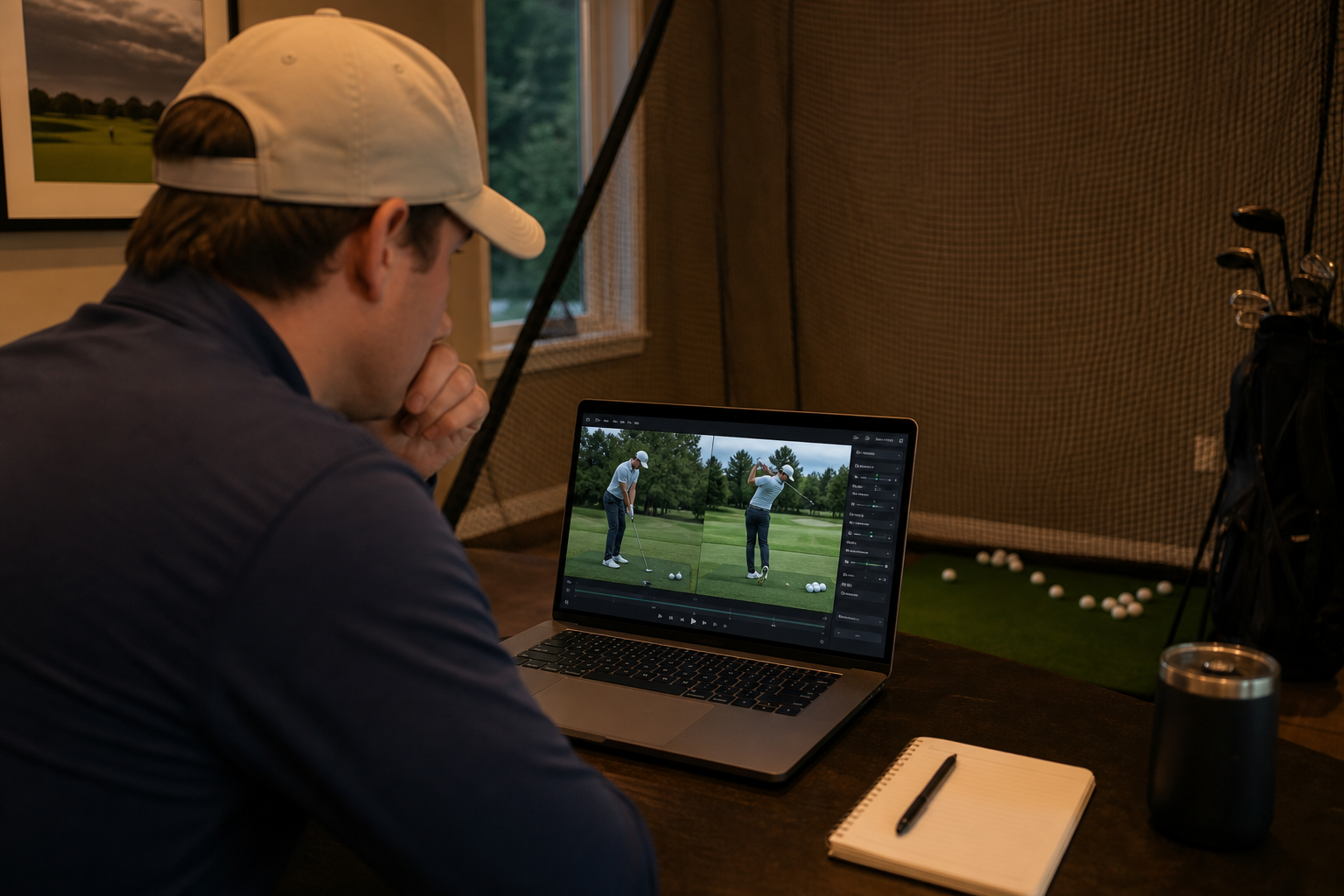
Reviewing footage at home is a core part of practicing online golf swing consistency drills effectively.
Frequently Asked Questions About Online Golf Swing Consistency Drills
What are online golf swing consistency drills?
Online golf swing consistency drills are structured practice exercises, delivered through video lessons and remote coaching feedback, designed to help golfers repeat the same swing mechanics shot after shot. They typically combine positional checkpoints, tempo work, and feedback tools so players can train without traveling to a facility.
How do online drills differ from in-person golf lessons?
Online drills rely on recorded or live video review instead of a coach standing beside you on the range. In exchange, they offer flexible scheduling and access to specialized instructors regardless of location.
How often should I practice swing consistency drills each week?
Most competitive golfers see steady progress practicing consistency drills three to four times per week in short, focused sessions. Shorter, more frequent sessions generally build repeatable patterns better than one long weekly block.
How long does it take to see results from swing consistency training?
Many golfers notice tighter shot dispersion within four to six weeks of consistent, focused practice. Full integration under tournament pressure, however, usually takes a full season of deliberate repetition.
Why does my golf swing break down under pressure?
Swings break down under pressure because stress increases muscle tension and rushes tempo, pulling the body away from trained movement patterns. Without ingrained mechanics, the nervous system defaults to tense compensations.
What equipment do I need for online swing consistency training?
A smartphone or tablet with a camera, a tripod, and alignment sticks cover most online training needs. Some programs also recommend impact tape or a simple launch monitor for deeper feedback.
How much does online golf swing coaching typically cost?
Online coaching packages vary widely, from single video-review sessions to monthly subscriptions covering ongoing analysis. Programs built on biomechanics-based coaching generally sit at a premium compared with generic swing tip subscriptions.
What is the biggest mistake golfers make with swing consistency drills?
The most common mistake is practicing too many drills at once instead of mastering one movement pattern at a time. This scattered approach confuses the nervous system and slows skill development.
Can beginners use online golf swing consistency drills, or are they only for advanced players?
Beginners can absolutely use these drills, though the entry points differ. Advanced players typically use them to fine-tune efficiency, while beginners use them to build sound fundamentals from the start.
What role does kinesiology play in improving swing consistency?
Kinesiology helps coaches identify exactly which joint actions and sequencing create a repeatable swing. This evidence-based approach replaces guesswork with measurable, biomechanically sound corrections.
How do I know if a drill is actually improving my consistency?
Track objective markers such as shot dispersion, divot direction, or clubface angle at impact across multiple sessions. If those numbers tighten over several weeks, the drill is working.
Do online swing drills work as well as face-to-face coaching?
For technical analysis and feedback, well-structured online coaching from a qualified instructor can match or exceed generic in-person lessons, especially with detailed video breakdown. The main trade-off is the absence of real-time physical cues a coach might otherwise provide in person.
Final Takeaway
Ultimately, online golf swing consistency drills work best when they follow a clear sequence: diagnose the fault, isolate one checkpoint, rehearse it slowly, and then test it under pressure. Rather than chasing every swing tip available, competitive golfers make faster progress by sticking with a single, well-structured program long enough for the new pattern to become automatic. Furthermore, grounding that process in kinesiology-based coaching, like the approach detailed throughout this guide and on yourgolfguru.com, helps ensure the gains are both measurable and sustainable. For golfers serious about tightening dispersion and performing under tournament pressure, consistent, science-backed practice remains the most reliable path forward.