


A golf swing biomechanics online course gives competitive players structured, science-based training they can complete from anywhere, pairing video swing analysis with kinesiology-driven feedback. Because scoring low at a high level demands more than tips from a local pro, many serious athletes now turn to remote programs built on movement science. This guide explains what this training actually covers, why it matters for performance and health, and how to choose a program worth your time.

Consistent, deliberate practice reinforces the mechanics taught in a golf swing biomechanics online course.
What Is a Golf Swing Biomechanics Online Course?
A golf swing biomechanics online course is a remote training program that studies how the body generates and transfers force through the golf swing, then applies that science to fix specific technical faults. Instead of generic tips, instruction is built on body mechanics, joint sequencing, and ground force use.
Typically, students submit swing video from multiple angles. In addition, instructors — often credentialed in kinesiology, the study of human movement — break down each phase of the swing: setup, backswing, transition, downswing, and follow-through. As a result, students receive a plan targeting the root cause of inconsistency, not just the symptom.
For instance, a golfer who struggles with early extension might receive hip-mobility drills alongside sequencing cues, rather than a vague note to “stay in posture.” That specificity separates biomechanics-driven coaching from casual lesson advice, and it forms the foundation of YourGolfGuru’s advanced swing mechanics coaching for elite golfers.
Why Swing Mechanics Matter for Competitive Golfers
Swing mechanics determine far more than ball flight; they dictate how much stress the body absorbs on every rep. Consequently, golfers who train without understanding their own biomechanics often plateau, or get hurt.
According to Mayo Clinic research on golf-related injuries, low back pain is one of the most common complaints among golfers and is frequently linked to repetitive, inefficient swing patterns. Therefore, correcting mechanics is not only a performance issue; it is a durability issue for anyone playing competitively across a long season.
Furthermore, small technical flaws compound under pressure. A swing that looks fine on the range can break down in tournament conditions once fatigue and nerves are introduced. For this reason, a credentialed instructor who diagnoses cause rather than symptom gives competitive players a measurable edge.
The Science Behind Biomechanical Swing Analysis
Biomechanics, a branch of science that studies movement using principles of physics and anatomy, allows instructors to measure things the eye alone misses. Specifically, this includes ground reaction force, segment sequencing — the order hips, torso, arms, and club move — and joint loading.
In golf, proper sequencing lets power transfer efficiently from the ground up, rather than relying on arm strength alone. Similarly, this is why a golf swing biomechanics online course built on kinesiology tends to outperform instruction based purely on visual cues. Measurable, repeatable mechanics replace guesswork, which matters enormously under tournament pressure.
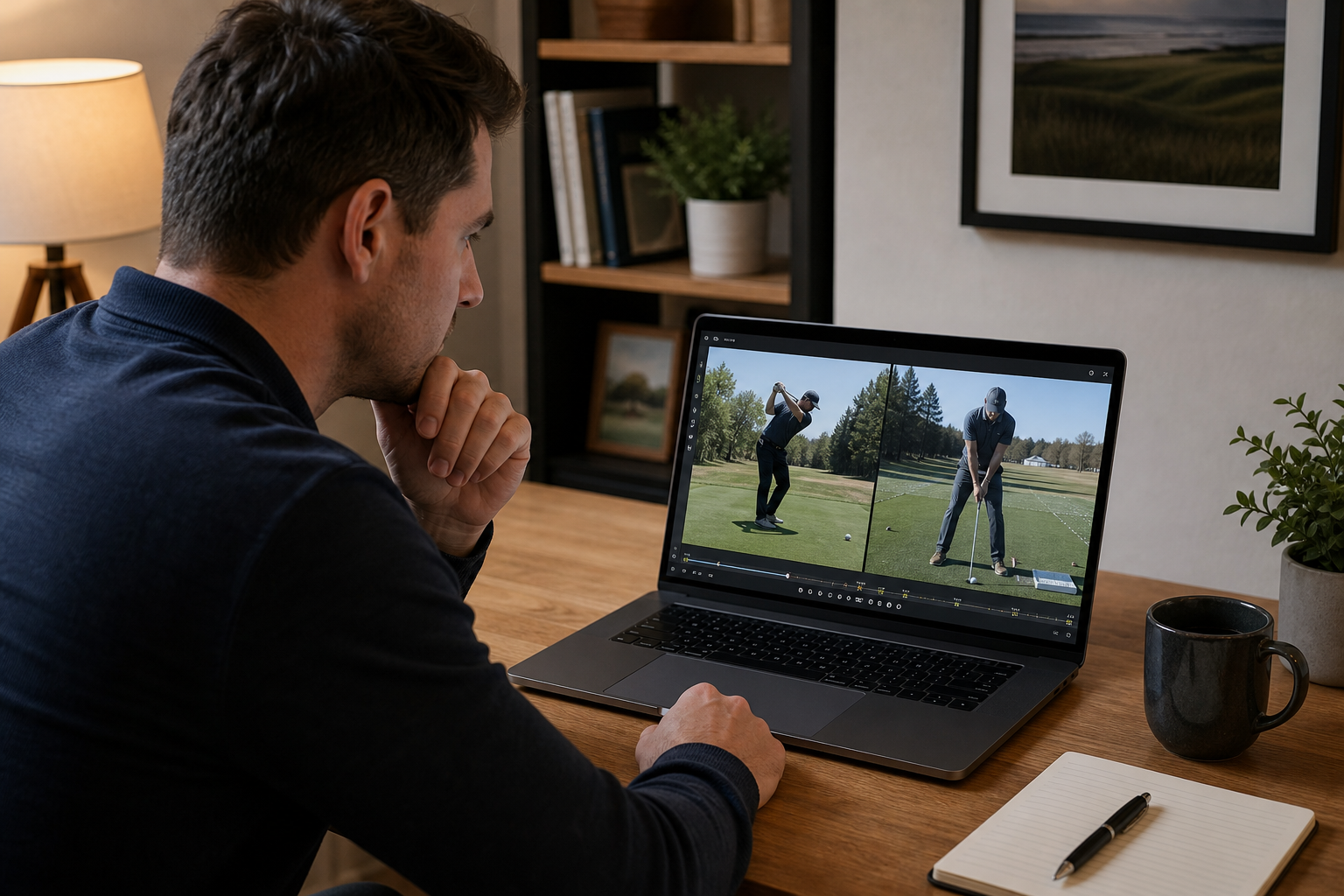
Frame-by-frame video review is central to remote biomechanics coaching.
How to Choose the Right Online Swing Biomechanics Program
Not every program labeled “biomechanics-based” delivers real science. Use the steps below to evaluate options before committing time and money.
- Verify the instructor’s credentials, such as LPGA or PGA master-level certification combined with formal education in kinesiology or a related movement science field, since this combination signals genuine technical depth rather than marketing language.
- Review sample lesson content to confirm the curriculum breaks the swing into measurable phases — setup, backswing, transition, downswing, impact, and follow-through — instead of offering generic tips that apply to every student the same way.
- Confirm the program includes personalized video swing analysis rather than pre-recorded, one-size-fits-all lessons, because individualized feedback is what allows an instructor to diagnose your specific technical faults accurately.
- Check whether injury prevention is built into the coaching philosophy, since sustainable swing changes should protect the spine, hips, and shoulders while still improving distance and accuracy.
- Test the platform’s communication and scheduling flexibility, confirming that remote delivery fits your competitive calendar and that you can reach your instructor between formal sessions for follow-up questions.
Programs such as YourGolfGuru’s customized swing coaching for elite golfers online are built around exactly this structure, pairing credentialed instruction with individualized video review.
What You’ll Learn in Golf Swing Biomechanics Training
A well-built curriculum covers far more than quick swing fixes. Typically, students progress through several connected areas of study.
First, instructors teach setup and grip fundamentals, since even advanced biomechanical correction fails if the foundation is flawed. Next, the curriculum addresses rotational sequencing: how the hips, torso, and arms should move relative to one another for efficient power transfer.
In addition, many programs incorporate ground force principles, teaching how pressure shifts through the feet to generate clubhead speed without excessive strain. Moreover, serious competitive programs use video comparison so students can track measurable changes over weeks, not just guess at improvement. For golfers wondering where to start, the best golf swing lessons available at YourGolfGuru.com outline a structured entry point.
Injury Prevention and Long-Term Performance
Above all, a responsible biomechanics-based program treats injury prevention as a core outcome, not an afterthought. Repetitive, high-speed rotation places real stress on the lumbar spine, lead hip, and trail shoulder.
As a result, instructors trained in kinesiology design swing adjustments that reduce harmful loading patterns while still improving clubhead speed and accuracy. For example, correcting early extension often resolves both a consistency problem and a long-term back-health risk at the same time. Consequently, golfers who train this way tend to sustain performance across a full competitive season rather than breaking down during peak tournament stretches.

Hip and torso sequencing is a frequent focus area in biomechanics-based swing training.
Online Course vs. Traditional In-Person Lessons: Which Wins for Competitive Golfers?
Both formats have a place in golf instruction, but they serve different needs. The table below compares factors competitive golfers typically weigh.
| Factor | Online Biomechanics Course | Traditional In-Person Lessons |
|---|---|---|
| Instructor credential depth | Often higher; not limited by location | Limited to local availability |
| Scheduling flexibility | High; fits a competitive calendar | Fixed by instructor and travel time |
| Video analysis depth | Structured, repeatable, trackable | Varies by instructor |
| Injury-prevention focus | Typically built into curriculum | Varies widely |
In contrast to local lessons limited by a single instructor’s availability, a remote biomechanics program can match competitive athletes with specialized expertise regardless of location. However, in-person coaching still offers value for very young beginners who need basic hand-eye coordination work before technical refinement matters. For competitive amateurs, collegiate players, and aspiring professionals, resources such as where serious golfers can find the best online swing lessons typically offer the specialized depth local options lack.
Who Should Enroll in a Biomechanics-Based Swing Program?
Not every golfer needs this level of technical depth, but certain groups benefit enormously. Competitive amateurs chasing lower handicaps, collegiate players preparing for a demanding season, and aspiring professionals refining tour-level mechanics are prime candidates.
Similarly, golfers recovering from a swing-related injury often benefit from kinesiology-informed coaching that addresses the mechanical cause of the original problem. In particular, players who have plateaued despite regular practice frequently discover the issue is sequencing or loading, not effort. For a deeper look at the diagnostic process itself, see this guide on how to analyze golf swing mechanics, which walks through the same framework used in structured biomechanics coaching.
Frequently Asked Questions
What is a golf swing biomechanics online course?
A golf swing biomechanics online course is a remote training program that uses movement science, video analysis, and expert feedback to improve swing power, accuracy, and consistency. It typically combines structured lesson content with personalized review from a credentialed instructor.
How does a golf swing biomechanics online course differ from in-person lessons?
The main difference is access and depth of credentialing. Online programs connect students with specialized expertise regardless of location, while in-person lessons depend on local availability.
Who benefits most from this type of training?
Competitive amateurs, collegiate golfers, and aspiring professionals benefit most, since they generally need more technical precision than general recreational instruction provides.
How much does a golf swing biomechanics online course typically cost?
Pricing varies depending on instructor credentials and how much personalized video review is included, ranging from affordable self-paced modules to premium one-on-one packages.
How long does it take to see results from biomechanics-based coaching?
Many golfers notice sequencing improvements within four to six weeks of consistent practice, though full motor-pattern change often takes two to three months.
What equipment do I need for an online swing biomechanics course?
Most programs only require a smartphone capable of recording swing video from face-on and down-the-line angles, plus a stable internet connection for lesson delivery.
Can beginners take a golf swing biomechanics online course?
These programs are built primarily for competitive and advanced players, but motivated beginners with solid fundamentals can benefit from early biomechanical correction.
What common swing faults does biomechanical analysis reveal?
Biomechanical analysis frequently uncovers early extension, poor hip-shoulder separation, over-the-top transition, and inefficient ground force use that normal-speed viewing misses.
How is injury prevention addressed in swing biomechanics training?
Instructors trained in kinesiology design corrections that reduce harmful loading on the spine, hips, and shoulders while still improving distance and accuracy.
What credentials should I look for in an online swing instructor?
Look for recognized teaching credentials, such as LPGA or PGA master-level certification, combined with formal education in kinesiology or a related movement science field.
How often should I train with golf swing biomechanics course material?
Most competitive golfers see the best results practicing assigned drills three to five times per week, with periodic video check-ins to confirm progress.
Can an online course replace in-person coaching entirely?
For many competitive golfers, a well-built online biomechanics course can fully replace in-person lessons, especially when travel to a qualified specialist isn’t realistic.
What makes biomechanics-based coaching different from typical golf tips?
Typical tips address symptoms, such as “keep your head still,” while biomechanics-based coaching identifies the underlying mechanical cause of a fault, making corrections more specific and longer-lasting.
Final Thoughts on Golf Swing Biomechanics Training
Ultimately, a golf swing biomechanics online course gives competitive golfers something generic lessons rarely offer: measurable, science-backed correction paired with a built-in focus on injury prevention. Because remote delivery removes geographic limits, elite-level expertise is no longer reserved for golfers near a major training hub. Instead, players can access LPGA Master Professional-level, kinesiology-based coaching from home, between tournaments, or during the off-season. For golfers serious about long-term performance, not just a quick fix, this approach offers a sustainable path forward. To explore a structured, credentialed program built on exactly these principles, visit YourGolfGuru.com and review the available coaching options.