

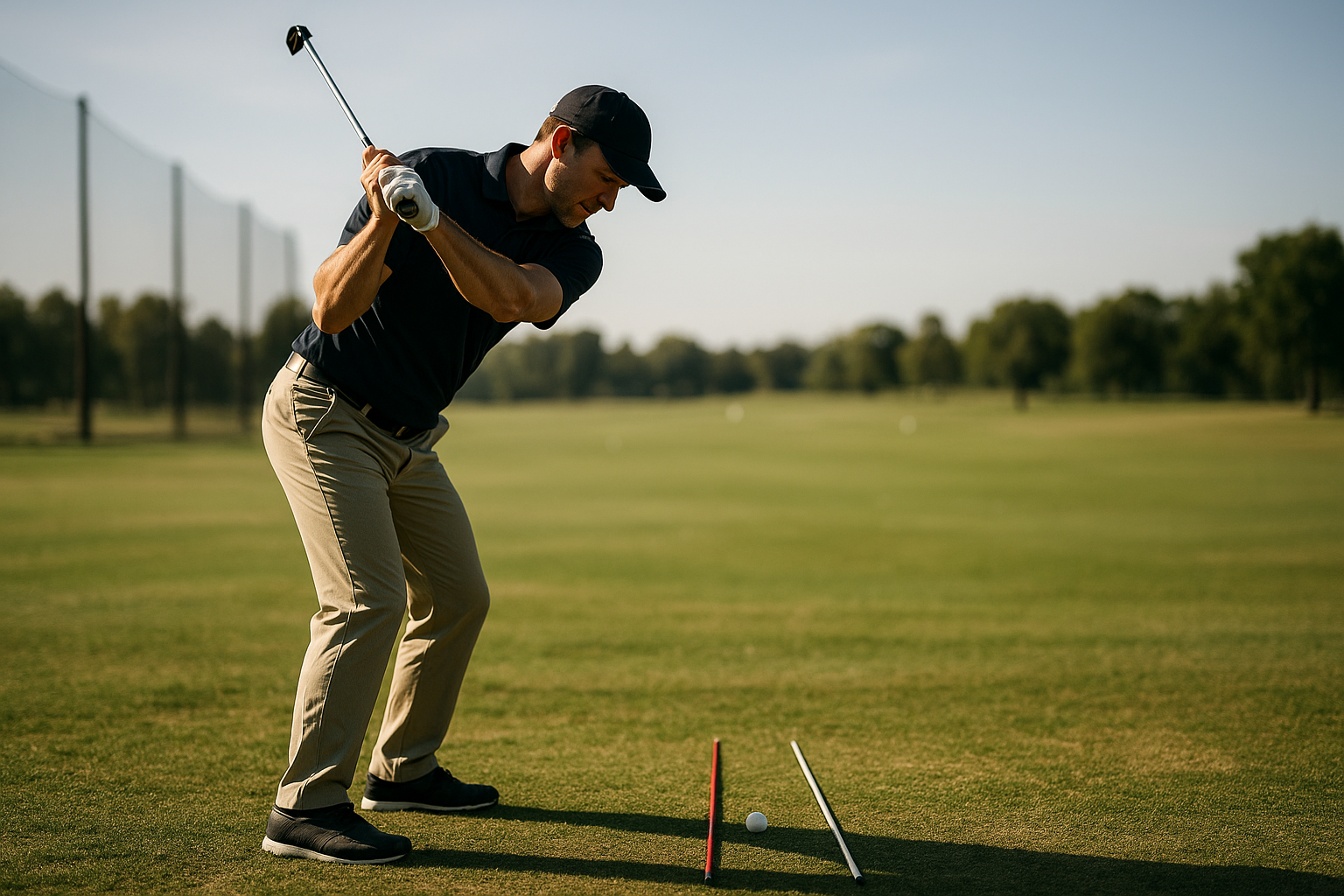
The best drills for golf swing accuracy share one trait: they isolate a single fault and give your body immediate feedback. Unlike grinding full-speed shots at the range, accuracy drills slow the swing down so the brain can actually absorb the correction. As a result, golfers who use them see tighter shot patterns far faster than those who simply hit more balls. This guide, informed by biomechanical coaching principles used at yourgolfguru.com, breaks down the drills that matter most for competitive and elite players.
Direct answer: The best drills for golf swing accuracy are the gate drill, the alignment stick path drill, the impact bag drill, the one-handed swing drill, and the mirror plane drill. Together they train clubface control, swing path, and impact position — the three mechanical factors that determine where a golf ball starts and how it curves.
What Are the Best Drills for Golf Swing Accuracy?
In short, the best drills for golf swing accuracy are repeatable exercises that isolate clubface angle, swing path, or impact timing, giving golfers precise feedback on a single variable at a time. This matters because accuracy is rarely caused by one giant flaw; it is usually a small, repeated error in one of those three areas. For instance, a slightly open clubface at impact of just two or three degrees can push a shot 10 to 15 yards off-line by the time it lands, according to swing-path research referenced by the golf swing overview on Wikipedia.
Consequently, coaches who understand biomechanics — the study of movement in living bodies — design drills that correct these small errors before they become ingrained habits. That is the approach used throughout the science-based swing training resources available for competitive players.
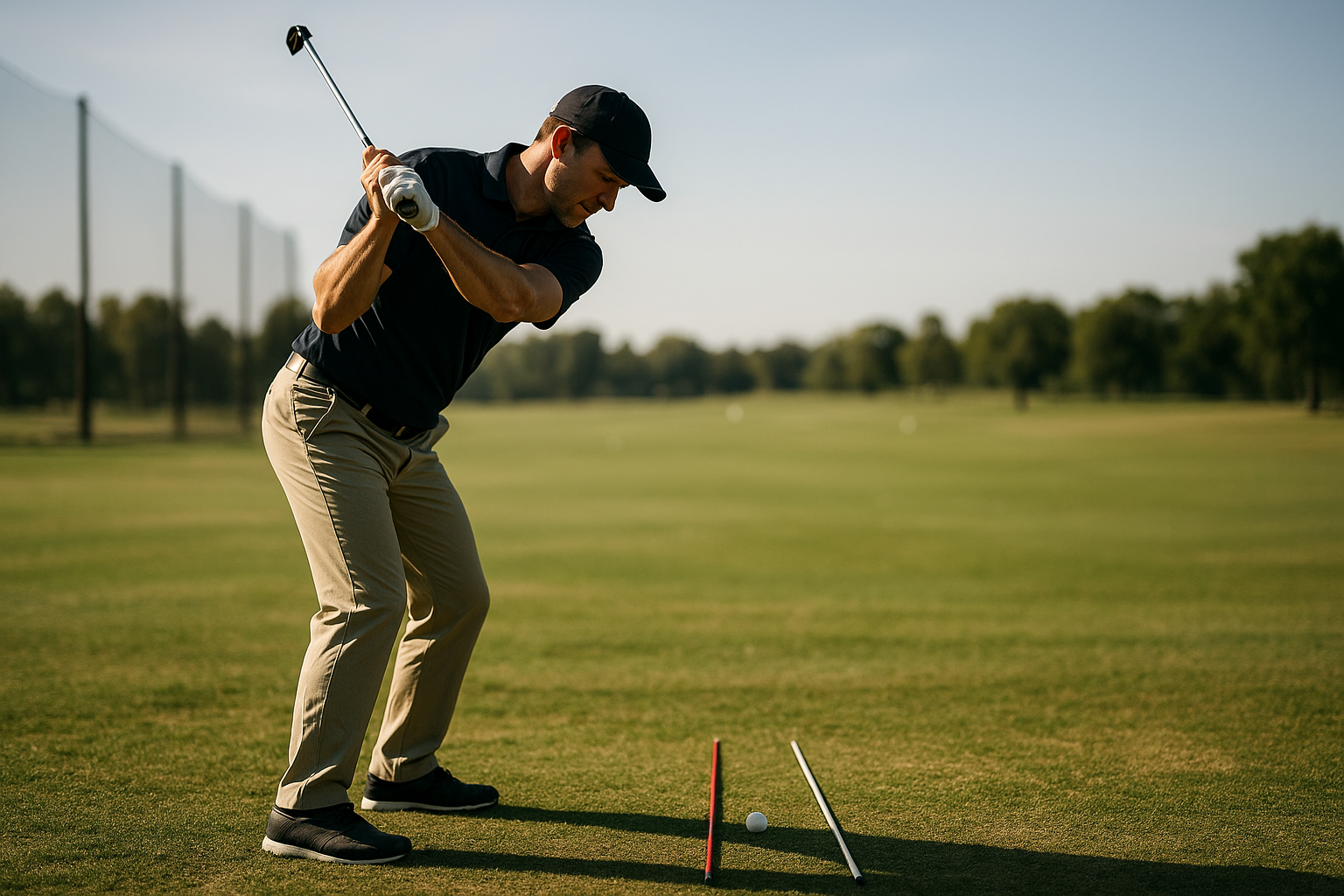
Alignment sticks help reinforce one of the best drills for golf swing accuracy by guiding swing path.
Why Precision Matters More Than Raw Power
Above all, scoring well in competitive golf depends on landing the ball near the target, not simply hitting it far. In fact, a longer drive that finishes in the rough or a hazard almost always costs more strokes than a shorter, centered shot. Therefore, elite coaches typically sequence training so that swing accuracy improvements are locked in before speed training is layered on top.
Similarly, the United States Golf Association notes that fairway and greens-in-regulation statistics correlate more strongly with scoring average than total driving distance at most competitive levels, a point reinforced by data published on USGA.org. In other words, accuracy is not a secondary skill — it is the foundation everything else is built on.
The Kinesiology Behind Accurate Ball Striking
Because the golf swing is a full-body movement, small breakdowns in sequencing — the order in which the hips, torso, arms, and club move — ripple into large directional errors at impact. Kinesiology, the scientific study of human movement, explains why a two-degree hip rotation timing error can translate into a significantly open or closed clubface. For this reason, instruction that blends biomechanical analysis with traditional coaching, like the methods outlined in this science-based performance guide, tends to produce more durable improvements than generic tips.
Top Drills to Improve Golf Swing Accuracy
Below is a sequenced set of drills that moves from clubface control through full swing path integration. Each step builds on the previous one, so it helps to practice them in order rather than jumping straight to full-speed swings.
- Gate Drill for Clubface Control: Place two tees or alignment sticks just wider than your clubhead on either side of the ball, then swing through without contacting either marker to train a square face at impact.
- Alignment Stick Path Drill: Lay one stick along the target line and a second angled stick just outside the ball to guide the club onto an inside-to-square path through the hitting zone.
- Impact Bag Drill: Swing into a stationary bag at roughly half speed, focusing on a flat lead wrist and square face, which builds the muscle memory needed for solid, centered contact.
- One-Handed Swing Drill: Hit short, controlled pitch shots using only your lead hand to sharpen grip pressure awareness and reinforce clubface stability through the strike.
- Mirror Plane Drill: Perform slow-motion backswings and downswings in front of a mirror to visually confirm the club tracks on a consistent, repeatable plane.

The gate drill is one of the best drills for golf swing accuracy because it gives instant feedback on clubface angle.
Common Mistakes That Sabotage Swing Accuracy
Even with the right drills, certain habits quietly undermine progress. First, many golfers practice at full speed before the new pattern is grooved, which causes the body to default back to old habits under pressure. Second, an inconsistent setup — ball position, alignment, or grip that shifts from shot to shot — makes it impossible to diagnose whether a miss came from setup or swing.
Additionally, rushing the transition from backswing to downswing disrupts the kinetic chain, the sequential transfer of energy from the ground through the body into the club. As a result, timing errors at the top of the swing often show up as pulled or pushed shots at impact. Finally, skipping video or launch-monitor feedback means players rely on feel alone, which research on motor learning suggests is unreliable for detecting small directional faults.
How to Practice Accuracy Drills Effectively
To get the most from these drills, follow a simple structure rather than practicing at random. The steps below outline a practical weekly approach used by competitive players working with remote coaching programs.
- Warm up with ten slow-motion mirror swings to prime the correct plane before hitting balls.
- Spend ten minutes on the gate drill, starting with short irons before progressing to longer clubs.
- Move to the alignment stick path drill for another ten minutes, tracking ball flight relative to the target line.
- Finish with impact bag work to reinforce the feeling of a solid, square strike.
- Log results after every session so progress in dispersion and consistency can be measured over weeks, not single sessions.
Consequently, this sequence trains the three core accuracy factors — face, path, and impact — in a logical order rather than leaving improvement to chance. For a deeper breakdown of swing mechanics that support this process, see this elite guide to ball striking mechanics.
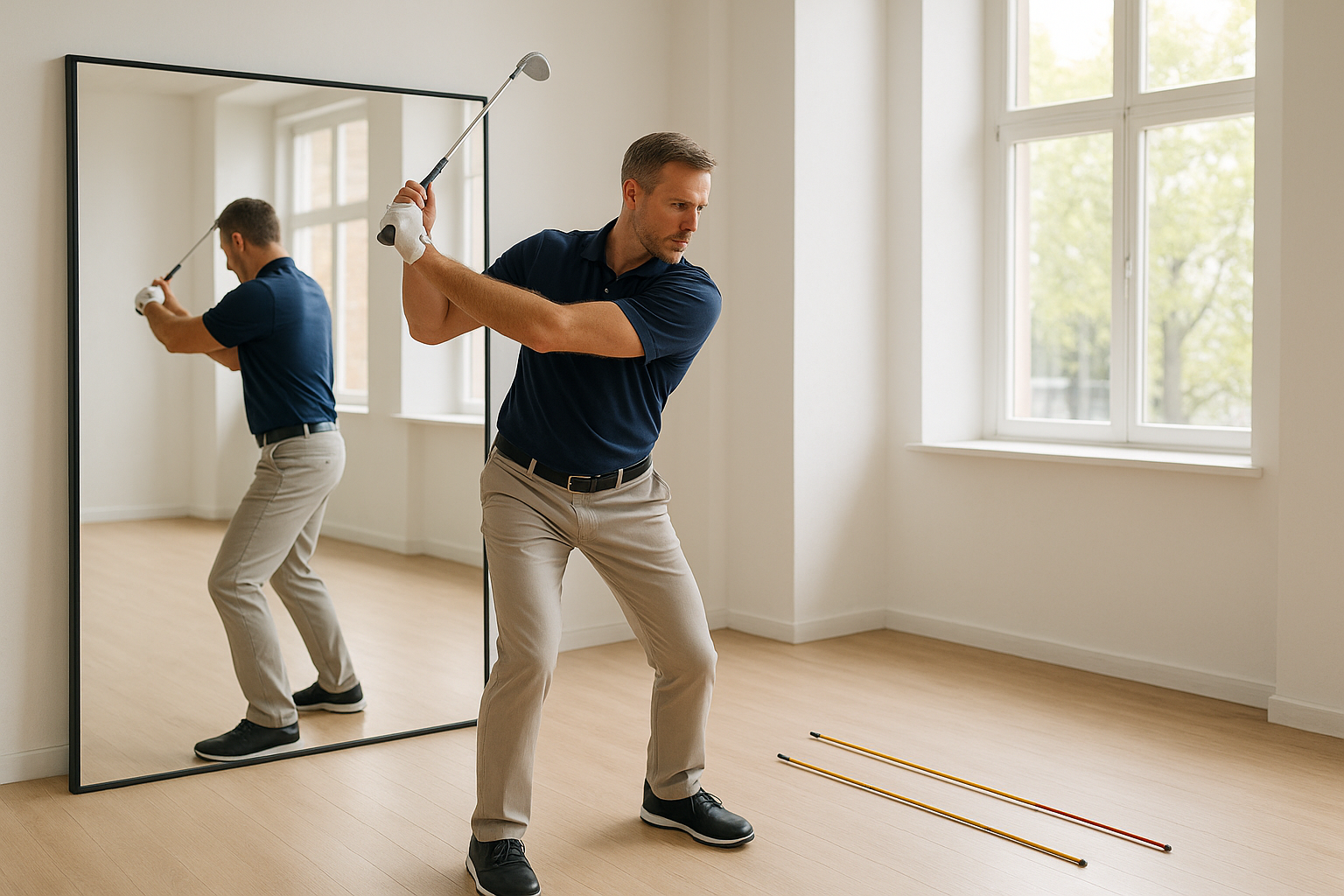
Reviewing swing plane in a mirror reinforces several of the best drills for golf swing accuracy at once.
When to Get Expert, Data-Driven Coaching
Although these drills work well independently, many competitive amateurs, collegiate players, and aspiring professionals eventually hit a plateau that self-coaching cannot solve. In that case, working with a coach who combines decades of teaching experience with a kinesiology background can pinpoint the exact biomechanical cause of a miss pattern. For example, remote coaching through a platform such as the exclusive golf tips and swing lessons program allows athletes anywhere to receive elite-level video analysis without traveling to a physical facility.
Likewise, players chasing a more complete understanding of elite ball-striking patterns may find it useful to study how top professionals sequence their swings, as discussed in this comparison of amateur and tour-level mechanics. In contrast to generic online tips, this kind of specific feedback addresses the individual flaws behind each golfer’s miss.
Frequently Asked Questions
What are the best drills for golf swing accuracy?
The best drills for golf swing accuracy include the gate drill for clubface control, alignment stick path drills, impact bag work, and one-handed swings. Each targets a specific mechanical fault so you get faster, measurable feedback than swinging at full speed without a focus point.
How long does it take to see results from accuracy drills?
Most golfers notice tighter dispersion patterns within two to four weeks of consistent, focused practice. However, permanent change in motor patterns typically takes six to eight weeks of repetition under a qualified coach’s guidance.
Why is swing path more important than clubhead speed for accuracy?
Swing path determines the initial direction and curvature of the ball, while clubhead speed only affects distance. A fast swing on a poor path simply sends the ball off-target faster, which is why accuracy work prioritizes path and face control first.
What is the difference between swing accuracy and swing consistency?
Accuracy refers to how close your shots land to the intended target on a given swing, while consistency measures how repeatable that outcome is across many swings. You can be occasionally accurate but inconsistent, or consistent but consistently off-target; elite ball striking requires both.
How much does online golf coaching cost compared to in-person lessons?
In-person lessons with advanced coaches often run $100 to $200 per hour, while remote, video-based coaching programs typically cost less per session because they remove travel and facility overhead. Online instruction also offers unlimited location flexibility for competitive players training between tournaments.
What equipment do I need for golf swing accuracy drills?
Most drills only require alignment sticks, an impact bag, and a mirror or smartphone for video review. A launch monitor or swing analyzer app adds helpful data but is not required to start improving accuracy.
How often should I practice swing accuracy drills each week?
Three to four focused sessions of 20 to 30 minutes per week produce better results than one long, unfocused range session. Short, repeated practice reinforces the correct motor pattern without fatigue-related breakdown in technique.
What common mistakes ruin golf swing accuracy?
The most common mistakes are an open or closed clubface at impact, an out-to-in swing path, and inconsistent setup alignment. Rushing the transition from backswing to downswing also disrupts sequencing and sends shots offline.
Can beginners use the same drills as competitive players?
Yes, the fundamental drills scale to any skill level because they address universal mechanics like face control and path. Beginners simply start at slower swing speeds and shorter clubs before progressing to full-speed, full-club repetitions.
How does kinesiology help improve golf swing mechanics?
Kinesiology, the scientific study of human movement, identifies which joints and muscle groups should sequence a golf swing for maximum efficiency and minimal injury risk. Applying this science lets coaches correct faults at their biomechanical root rather than only treating surface symptoms.
What is the gate drill in golf?
The gate drill places two tees or alignment sticks just wider than the clubhead on either side of the ball. Successfully swinging through the gate without contact trains a square, on-path clubface at impact.
Should I prioritize accuracy or distance first?
Accuracy should generally come first because distance without direction rarely lowers scores. Once a repeatable, on-target swing is established, players can safely add speed and distance training on top of that foundation.
How can I measure my swing accuracy progress?
Track shot dispersion by marking where balls land relative to a target line over sets of ten shots. Reviewing swing video alongside launch data, when available, also reveals whether face angle and path are trending in the right direction.
Final Thoughts
In summary, the best drills for golf swing accuracy work because they isolate clubface, path, and impact rather than asking the body to fix everything at once. By sequencing the gate drill, alignment stick work, impact bag training, one-handed swings, and mirror plane checks, golfers build a repeatable, on-target motion that holds up under tournament pressure. For players who want this process guided by a coach with elite credentials and a kinesiology-based approach, resources like those found at yourgolfguru.com offer a science-backed path forward. Ultimately, consistent, targeted practice — not more range balls — is what turns accuracy drills into lower scores.