

How to correct golf swing path errors starts with understanding exactly where your clubhead travels through impact relative to your target line. Many competitive golfers struggle with a slice, hook, or inconsistent ball flight because their swing path drifts too far inside-out or outside-in during the downswing. Fixing this issue requires accurate diagnosis, focused drills, and, for serious players, biomechanical analysis from a qualified coach. Consequently, this guide breaks down the most common path errors, explains why they happen, and walks through a step-by-step correction process used by elite-level instructors.
Quick Answer: To correct a golf swing path error, first identify whether your club travels too far inside-out (causing a hook) or outside-in (causing a slice). Then, retrain the correct path using alignment-stick drills, video feedback, or a coach’s biomechanical assessment. Most golfers see measurable improvement within two to four weeks of consistent, focused practice.
What Is a Golf Swing Path Error?
A golf swing path error is a measurable deviation between the direction the clubhead travels at impact and the target line. In other words, swing path is not about where the club points, but where it is actually moving. According to TrackMan University research, tour professionals average a path within 1 to 2 degrees of neutral, while amateurs frequently show deviations of 5 degrees or more, which directly explains many chronic slices and hooks. As a result, even small path corrections can produce dramatically straighter shots.
It helps to distinguish swing path from swing plane, a related but different concept. Swing plane describes the tilted circle the club traces throughout the entire motion, while path refers specifically to the club’s direction at the single moment of impact. Understanding this distinction is essential before attempting any fix, since correcting the wrong variable wastes practice time and can introduce new compensations.

Alignment-stick gates are one of the most effective tools for learning how to correct golf swing path errors on the range.
How to Correct Golf Swing Path Errors: A Step-by-Step Process
Once you know your path tendency, the correction process follows a logical order. Below is the sequence used by biomechanics-trained coaches to retrain a faulty path safely and permanently, rather than masking it with a temporary compensation.
- Diagnose your current swing path. Record your swing from behind the ball, or better yet, use a launch monitor to get an exact degree measurement before changing anything.
- Check your grip and setup alignment. Shoulder alignment, grip strength, and ball position frequently cause the path fault in the first place, so rule these out first.
- Retrain path with alignment-stick drills. Build a physical gate outside the ball and practice swinging through it without contact to reroute the club’s direction at impact.
- Use video or launch-monitor feedback. Review your numbers after every session to confirm the new pattern is replacing the old fault, not simply blending with it.
- Work with a biomechanics-based coach for fine-tuning. A qualified expert can safely refine the correction while protecting your joints from unnecessary strain.
Common Causes of an Off-Plane Swing Path
Several recurring faults push the club off its ideal path. For instance, an early shoulder turn in the downswing often steers the club outside the line, creating the classic over-the-top swing pattern that even tour players occasionally fight. Similarly, a grip that is too weak encourages an out-to-in path, while an overly strong grip can trap the club too far behind the body and produce an in-to-out hook.
In addition, poor weight transfer is a hidden contributor. If the lower body stalls or slides too far forward before the arms deliver the club, the path compensates in unpredictable ways. Above all, these causes rarely occur in isolation, which is why isolated fixes so often fail without a full biomechanical review.
Drills That Fix an Outside-In Swing Path
For golfers battling a slice, the gate drill described above is a strong starting point. However, pairing it with a slow-motion, half-speed rehearsal helps the body learn the new feel without reverting to old habits under speed. Furthermore, checking impact position on a foam roller or towel drill reinforces the correct low-point contact that naturally supports a better path.
It is also worth reviewing whether a flawed setup position is quietly sabotaging your progress. Our breakdown of one commonly overlooked swing position explains how a single setup flaw can undo weeks of path-correction drills. For a more comprehensive framework, our science-based guide to swing correction techniques walks through additional biomechanical drills in greater depth.
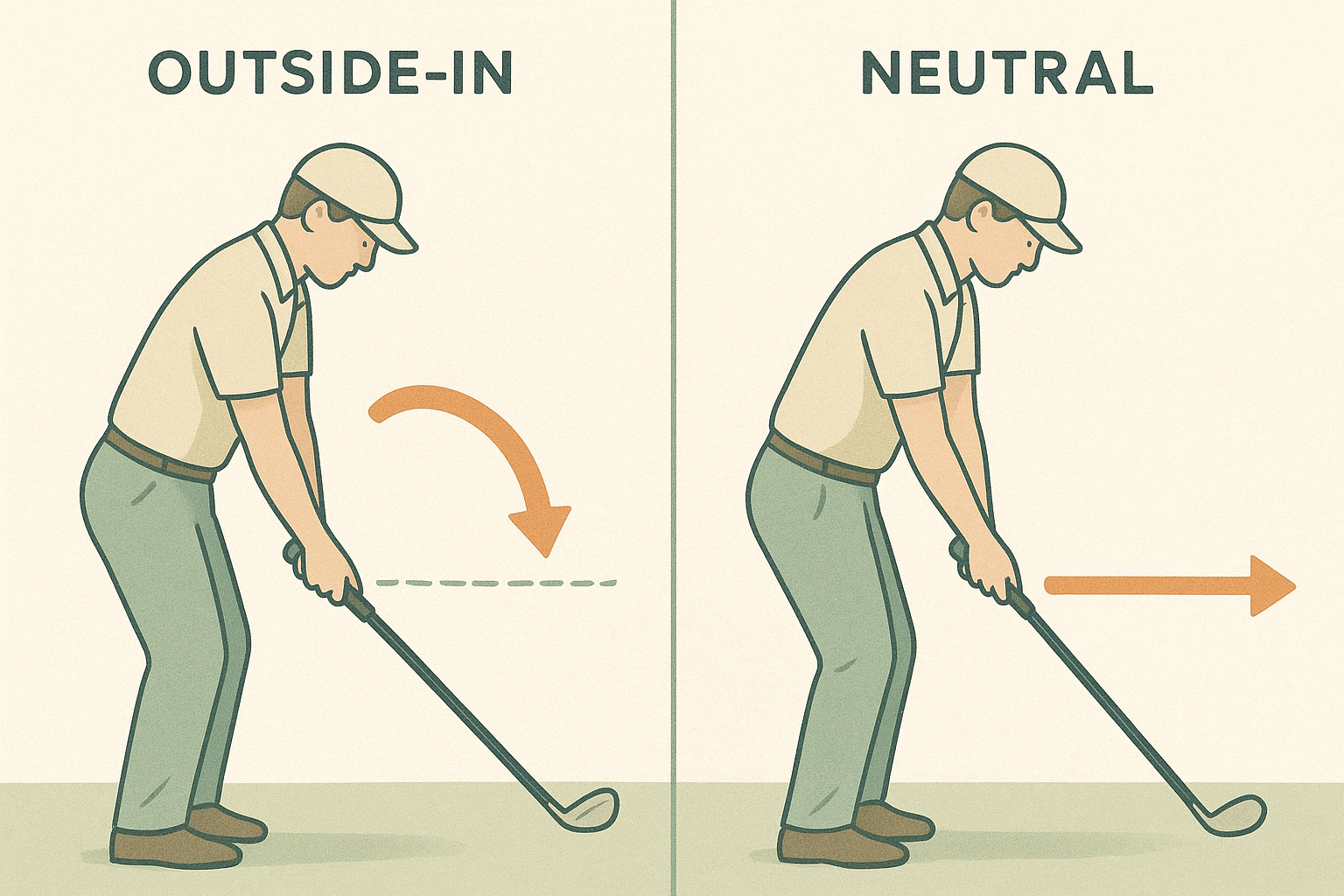
Comparing an outside-in path to a neutral path helps illustrate exactly how to correct golf swing path errors before the next practice session.
Why Professional Swing Path Analysis Matters for Competitive Players
Self-correction works for casual golfers, but competitive amateurs, collegiate players, and aspiring professionals typically need a deeper level of analysis. Indeed, small path errors that seem invisible at slow speed often reappear under tournament pressure. A kinesiology-trained coach can identify whether the path fault stems from joint mobility limits, sequencing issues, or old compensations built up over years of play.
This is precisely the gap that remote, science-based coaching fills. Our detailed look at hidden swing myths golfers often believe shows why many self-taught fixes fail to hold up under pressure. Likewise, the cautionary lessons in this piece on swing changes gone wrong highlight why data-backed, injury-aware correction matters more than guesswork. For golfers who want a full biomechanical review from an LPGA Master Professional with a PhD in kinesiology, yourgolfguru.com offers remote coaching that removes the need to travel to a physical facility.
According to the USGA, consistent contact and directional control remain among the strongest predictors of scoring average at every competitive level. Therefore, treating swing path as a technical, measurable variable rather than a vague feeling gives serious players a real, repeatable edge.
Frequently Asked Questions
What is a golf swing path error?
A golf swing path error occurs when the clubhead travels too far inside-out or outside-in relative to the target line at impact, producing a hook, slice, or pull. It is one of the primary ball-flight factors measured alongside face angle and attack angle.
How do I know if my swing path is off?
The clearest sign is a repeating slice, hook, or push that shows up shot after shot, especially under pressure. A launch monitor or coach’s video review can confirm the exact path number in degrees.
How to correct golf swing path errors quickly?
To correct golf swing path errors quickly, isolate the fault with video or a launch monitor, then use an alignment-stick gate drill on every rep. Most golfers notice a measurable shift within two to four weeks of focused practice.
What causes an out-to-in swing path?
An out-to-in, or over-the-top, path usually stems from an early shoulder turn, poor weight transfer, or a grip that is too weak. This sends the club across the ball, typically producing a slice.
What causes an in-to-out swing path?
An in-to-out path often results from excessive lower-body rotation, a strong grip, or the arms getting trapped behind the body. This pattern frequently produces a hook depending on the clubface angle.
How long does it take to fix a swing path issue?
Most competitive players notice initial improvement within two to four weeks of dedicated drill work. However, fully ingraining the new path on the course can take two to three months.
What is the difference between swing path and swing plane?
Swing path describes the clubhead’s direction at the moment of impact relative to the target line. Swing plane, in contrast, describes the tilted circle the club traces throughout the full swing.
Do I need a launch monitor to fix my swing path?
A launch monitor speeds up diagnosis significantly, but it is not strictly required. Video analysis combined with alignment-stick drills can reveal and correct most path issues effectively.
How much does professional swing path correction cost?
In-person biomechanics-based coaching typically ranges from $150 to $400 per hour depending on credentials and location. Remote, science-based online coaching often costs less while still providing detailed data feedback.
What are common mistakes when trying to fix swing path?
The most common mistake is chasing feel-based fixes without objective feedback, which often overcorrects in the opposite direction. Golfers also frequently ignore grip and setup, which are usually the root cause.
Can a bad swing path cause injury?
Yes, compensating for a poor swing path often forces the body into unnatural positions that stress the lower back, wrists, and lead knee. A biomechanics-informed correction reduces this risk while improving ball flight.
What is the ideal swing path for a driver versus irons?
Tour averages show a slightly in-to-out path of about 1 to 3 degrees with the driver, and a more neutral path with short irons. These differences reflect the swing’s natural attack angle at each club length.
Should beginners worry about swing path?
Beginners generally benefit more from grip, posture, and contact fundamentals before fine-tuning path numbers. Competitive and advanced players, however, should prioritize path correction since it directly affects scoring consistency.
How can online coaching help correct swing path errors?
Online coaching allows a qualified instructor to review swing video and data remotely, removing geographic barriers to elite-level feedback. This is especially valuable for competitive amateurs and collegiate players without local access to a biomechanics-trained coach.
Final Thoughts on Correcting Your Swing Path
Ultimately, learning how to correct golf swing path errors comes down to accurate diagnosis, targeted drills, and honest feedback. Whether your tendency is inside-out or outside-in, the fastest, safest progress comes from combining alignment-stick drills with video or launch-monitor data rather than relying on feel alone. For competitive golfers chasing consistent, injury-free improvement, pairing that drill work with biomechanically informed coaching offers the clearest path to a repeatable, tournament-ready swing.