


Advanced golf swing techniques are what separate consistent low-scorers from golfers who plateau despite years of practice. However, most weekend players never move beyond basic setup and tempo work, leaving significant power and accuracy on the table. In particular, competitive amateurs, collegiate athletes, and aspiring professionals need swing mechanics grounded in biomechanics, the science of human movement, rather than guesswork. This article breaks down the specific techniques elite coaches use, why they work, and how to train them safely.
Quick answer: Advanced golf swing techniques refer to biomechanically optimized movement patterns, such as efficient kinematic sequencing, ground force generation, and torso-pelvis separation, that increase clubhead speed, ball-striking accuracy, and swing repeatability for competitive golfers.
What Are Advanced Golf Swing Techniques?
Advanced golf swing techniques are refined movement strategies built on top of fundamental mechanics. Specifically, they involve sequencing the body’s segments in a precise order so energy transfers efficiently from the ground, through the hips and torso, and finally into the club. As a result, players generate more speed with less physical strain.
Unlike basic instruction, which focuses on grip, alignment, and simple contact, these methods target the underlying biomechanics of rotation, force production, and timing. Therefore, they typically require professional analysis, whether through video review or motion-capture technology, to apply correctly and safely.

Proper rotation at the top of the swing is a foundation of advanced golf swing techniques.
Why Elite Swing Mechanics Matter for Competitive Players
Competitive golf rewards consistency under pressure, not just occasional great shots. Consequently, players who rely on natural talent alone often struggle when facing tournament conditions, fatigue, or difficult lies. In contrast, golfers trained in refined swing mechanics can repeat their motion reliably because it is built on efficient, low-stress patterns.
Furthermore, research on golf biomechanics published through resources indexed by the golf swing literature shows that elite players achieve significantly higher peak hip and shoulder rotation speeds than amateurs. Above all, this rotational efficiency, not raw strength, accounts for much of the distance gap between tour professionals and recreational golfers.
Similarly, injury prevention becomes a bigger concern at higher swing speeds. A swing built on sound biomechanical principles reduces unnecessary stress on the lumbar spine and shoulders, which matters greatly for golfers training year-round. For golfers wanting a broader perspective on rethinking swing fundamentals, thinking outside the golf swing box is worth exploring alongside these techniques.
Core Advanced Golf Swing Techniques Used by Elite Golfers
Elite coaching typically centers on a handful of proven concepts. Below are the techniques most frequently used to raise power, accuracy, and consistency at a competitive level.
Kinematic Sequencing for Power
The kinematic sequence, the order in which the hips, torso, arms, and club accelerate during the downswing, is arguably the single most important factor in generating clubhead speed. Ideally, the hips begin rotating first, followed by the torso, then the arms, and finally the club. As a result, energy builds like a whip, transferring maximum speed into impact.
X-Factor and Torso-Pelvis Separation
The “X-factor” refers to the angle of separation between the shoulders and hips at the top of the backswing. Notably, greater separation, when trained safely, allows for a longer stretch-shortening cycle in the core muscles, which increases stored elastic energy available for the downswing.
Ground Reaction Forces
Advanced players use the ground actively, pushing down and rotating against it to generate vertical and rotational force. In fact, studies on golf biomechanics available through PubMed research databases indicate that ground reaction force timing correlates strongly with clubhead speed among skilled players. Therefore, footwork and lower-body loading deserve as much attention as arm mechanics.
Data point: Research on elite versus amateur golfers has found that skilled players can generate roughly 20 to 25 percent more peak hip rotation speed during the downswing, a key contributor to the distance gap between competitive and recreational golfers.
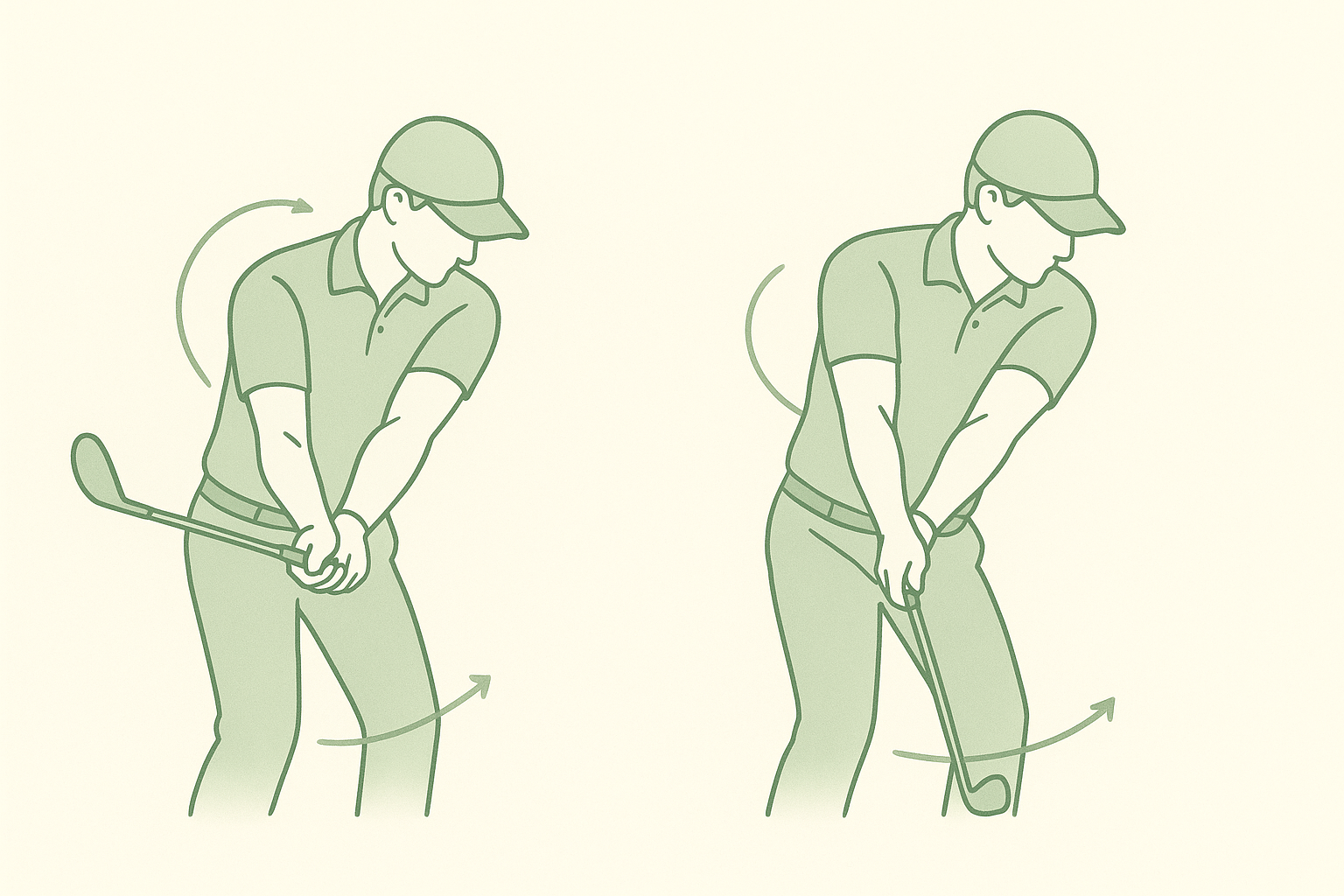
Efficient sequencing between the hips and shoulders drives clubhead speed.
How to Develop Refined Swing Mechanics Step by Step
Building advanced golf swing techniques is a gradual process. Below is a structured approach coaches commonly use with competitive players.
- Record a baseline video or motion-capture assessment of your current swing to identify existing sequencing patterns before introducing any advanced changes.
- Work on hip and thoracic spine mobility drills several times per week, since restricted rotation limits how effectively advanced sequencing can be applied.
- Practice slow-motion transition drills that emphasize starting the downswing with the lower body before the arms and club, reinforcing proper energy transfer order.
- Incorporate step-change and pressure-shift drills that teach the body to load into the ground and push off explosively for additional clubhead speed.
- Retest with video or launch monitor data every few weeks and review results with a qualified coach to confirm the new mechanics are consistent under pressure.
Golfers who want more distance-specific drills can also review strategies for hitting the ball further, straighter, and higher, which complement this sequencing work well.
Common Mistakes When Training Advanced Swing Techniques
Even motivated players make avoidable errors when adopting advanced concepts. For example, many golfers try to speed up their hands instead of trusting proper sequencing, which often produces inconsistent contact. Others skip mobility training entirely, so their bodies physically cannot access the positions the technique requires.
In addition, practicing without objective feedback, such as video or launch monitor data, makes it nearly impossible to confirm whether real change is happening. Consequently, working with a qualified coach who can interpret this data becomes essential, particularly for golfers making swing changes during a competitive season. Younger players building fundamentals first should review this minimalist golf swing approach for junior golfers before layering in advanced concepts.
Choosing the Right Coaching for Advanced Golf Swing Techniques
Not every instructor is equipped to teach advanced golf swing techniques at a competitive level. Above all, look for coaching grounded in biomechanics and backed by real credentials rather than generic tips. Your Golf Guru, for instance, delivers remote instruction developed by an LPGA Master Professional who also holds a PhD in kinesiology, blending scientific analysis with decades of elite teaching experience. Author: LPGA Master Professional (PhD, Kinesiology). Last updated: 2026-08-16.
Because instruction is delivered digitally, competitive amateurs, collegiate players, and aspiring professionals can access this level of coaching regardless of location. As a result, golfers no longer need a nearby training facility to receive data-driven, safety-focused guidance. Golfers planning a serious improvement push this season may also find it useful to review how to make this your best golf year for a broader training framework.
One frequent technical fault worth understanding on its own is the over-the-top move, which undermines even well-intentioned sequencing work. For a deeper look, see this breakdown of why even professional golfers still swing over the top. For more on the coaching philosophy behind this approach, visit Your Golf Guru directly.

Video analysis helps confirm progress when training advanced golf swing techniques remotely.
Frequently Asked Questions About Advanced Golf Swing Techniques
What are advanced golf swing techniques?
Advanced golf swing techniques are refined swing methods, such as optimized kinematic sequencing, ground force utilization, and torso-pelvis separation, that competitive and elite golfers use to increase power, accuracy, and consistency beyond basic fundamentals.
How long does it take to learn advanced golf swing techniques?
Most competitive golfers see measurable improvement within 8 to 12 weeks of focused practice. However, full integration into competitive play often takes a full season of repetition and coaching feedback.
Why do advanced golf swing techniques improve distance?
These techniques sequence the body’s segments, hips, torso, arms, and club, so energy transfers efficiently from the ground up. As a result, players generate more clubhead speed without added muscular effort.
What is the kinematic sequence in golf?
The kinematic sequence describes the order in which body segments accelerate and decelerate during the swing, typically hips first, then torso, arms, and finally the club, to maximize speed transfer.
How much does online golf coaching cost compared to in-person lessons?
Online coaching programs are generally more affordable than repeated in-person sessions with a specialized instructor, since they remove travel costs while still offering personalized, data-backed feedback.
What is the difference between basic and advanced swing techniques?
Basic techniques focus on grip, stance, and simple ball contact. In contrast, advanced golf swing techniques address biomechanical efficiency, power transfer, and injury prevention for players competing at a higher level.
Can beginners learn advanced golf swing techniques?
Beginners should first master fundamentals like posture and contact before layering in advanced concepts. Otherwise, attempting complex sequencing too early can reinforce compensations instead of correcting them.
What common mistakes happen when practicing advanced swing techniques?
Common mistakes include overemphasizing hand speed instead of sequencing, skipping mobility work, and practicing without video or data feedback, which makes it difficult to confirm real progress.
How can I improve my X-factor stretch?
Improving the X-factor stretch, the separation between hip and shoulder rotation at the top of the backswing, requires targeted mobility drills and controlled backswing tempo practiced under coaching guidance.
Is online golf instruction effective for advanced swing training?
Yes, online instruction can be highly effective when it includes video swing analysis and structured feedback loops. As a result, coaches can identify mechanical faults just as precisely as an in-person session.
What equipment helps analyze advanced golf swing techniques?
Slow-motion video capture, launch monitors, and motion-tracking sensors are commonly used tools that help coaches and players quantify swing sequencing, clubhead speed, and body rotation.
How often should competitive golfers train advanced swing mechanics?
Competitive golfers typically benefit from two to three focused technical sessions per week, paired with on-course practice, to reinforce new mechanics without overloading the body.
Final Thoughts on Advanced Golf Swing Techniques
In summary, advanced golf swing techniques give competitive golfers a measurable edge by improving power, accuracy, and consistency through better sequencing, ground force use, and safe biomechanics. Therefore, players serious about long-term improvement should prioritize coaching grounded in science rather than trends. Ultimately, whether training locally or remotely, the combination of expert analysis and structured practice remains the most reliable path to mastering advanced golf swing techniques and sustaining performance over an entire competitive career.