Low back spasms can end a golf round in a single swing, and they even stopped Rory McIlroy at the 2023 Tour Championship. A spasm is an involuntary muscle contraction that guards an irritated area. In golf, it often follows repeated side bend, rotation and speed in the lumbar spine. Below, we look at what happened to Rory, why the swing may have triggered it, and which swing changes can reduce strain on the low back.
What Are Low Back Spasms in Golf?
Low back spasms are sudden, tight muscle contractions in the lumbar area. They can feel like a seizing, catching or locking sensation. According to the Mayo Clinic’s overview of back pain, back pain has many possible causes, including strained muscles and ligaments. A spasm is often the body’s protective response.
Golf is a particularly good way to provoke one. The swing repeats forward flexion, side bend and rotation, often at high speed. Consequently, the muscles around the lumbar spine work hard, round after round.
Rory McIlroy and Low Back Spasms at the Tour Championship, August 2023
A Golf Channel announcer said Rory tweaked his low right side during a gym session on Tuesday, August 22nd. He then played the Tour Championship while managing the problem.
What Rory said he could not do
On Friday, August 25th, 2023, Rory described his numbers this way: “Half club off. Hard to get right side through ball. Better with longer clubs because more upright. With the shorter stuff (clubs) trying to stay in my posture is a struggle. So coming out of it, just swinging my arms at it, and missing a lot of iron shots left. Tried to manage it and did the best I could.”
A reporter then asked, “Rory, What can you do? What are you limited with?” He answered:
“Can’t hit the ball left to right. Can’t swing my irons the way I want to, can’t turn my right side through the ball. From the top of the swing just throwing my arms at it… Can only hit it one way with the irons. Can’t hit the driver the way I usually do, just teeing down my driver and hitting a flat little runner. Missing irons shots left because hard to staying posture.”
Notice the pattern. Shorter clubs put the golfer in more forward bend, and that is where he struggled most. Longer clubs sit more upright, so they felt better.
When did the spasms start? Three conflicting reports
The media gave different accounts of the inciting incident. In fact, they are hard to reconcile.
- Talksport.com reported Rory speaking after his Thursday, August 24th round: “I was at the bottom of a squat, a body-weight squat, and my whole lower back spasmed, seized up. I couldn’t move. I honestly couldn’t address the ball this time yesterday.”
- Sports Illustrated, the same day, quoted him: “It’s a muscle spasm that’s being protective of, you know, like my ribs, joints, everything.” He added, “I think when I play a lot of golf, especially the end of the season, I always have to manage my right side. My right side always gets pretty tight, my rib cage, intercostals, lats, like, all the way down, right hip.”
- Golf.com, on August 27th, said he injured his back on Monday in an unexpected way: throwing his daughter Poppy in a pool while relaxing with his family.
Whatever the exact trigger, he clearly has had right-side pain, from the ribs down, for some time. Therefore, this looks more like a chronic overuse issue than a purely acute one.
What Causes Low Back Spasms in the Golf Swing?
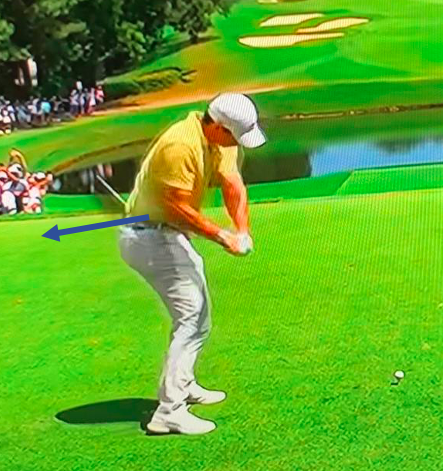
The probable cause of Rory’s lumbar spine and low back trouble is too much right side bend combined with rotation, especially when it is made at high speed. The screen shot below is from live TV coverage during the Tour Championship itself.

For a broader look at how these loads affect golfers, see our summary of what the research says about low back pain in golf. Likewise, back pain in professional golfers shows that Rory is far from alone.
Why a Sore Back Causes Left-Right Misses Under Pressure
If you watch Rory on a driving range next to other pros, he makes them look like beginners. His ball striking is so pure and his ball so well-compressed. Even so, he leaks balls slightly left or right, even in practice.
The trail elbow sign
One sign that a swing will randomly miss left or right under pressure is the trail (right) elbow position. Before impact it points behind the golfer. Just after impact it points down-the-line (see the blue arrow in the first picture above). When it points down-the-line at impact, it indicates trail forearm rotation. As a result, the rate of clubface closure becomes unpredictable.
The trail elbow is only a visual sign of what not to do. Ideally, at impact, the upper torso (thorax) is very slightly closed to the target. That way the trail forearm cannot rotate until well past impact, which keeps the clubface square.
Swing Changes That Reduce Low Back Spasms and Pain
During those very same days, Phil F. (69 years old) visited from Maryland. He had undergone a microdiscectomy for an L5-S1 disc bulge and numbness caused by pinched nerves. He was two months post surgery. We worked on his full swing and short game for six days.
Injury solutions: a more stable, upright lower body
We used minimally flexed hips at address and throughout the backswing. We also used the least possible knee flexion and pelvis rotation during the backswing (see the screen shot below). Together, these changes put less strain on the low back through three effects:
- A more upright spine
- Less rotating of the lumbar spine in the downswing
- Less side-bending of the lumbar spine in the downswing
These are the three main researched causes of lumbar disc herniation. My LPGA Master Thesis covers them in detail, and the link is on the home page of this website.
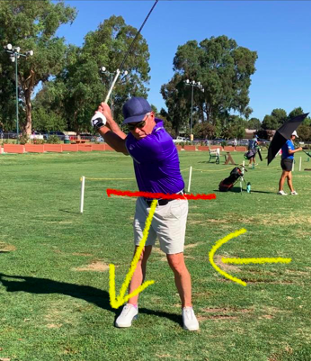
Performance solutions: a stable backswing lets big muscles work
This stable backswing also helps performance. It lets the big muscles fire forcefully off firmly planted legs. These include the trail latissimus dorsi, pectoralis major, serratus anterior and external oblique. Compare the excessive pre-backswing movement with the very stable post-backswing in the picture below.

The result? Strong, powerful, balanced impact.

Measured results with Sportsbox AI
At the start of every day, we recorded a Sportsbox AI video. On day 1 he used his 7 iron, and on day 5 he used his 8 iron. The results are below.

The moral of the story: big muscles doing their job. However, results varied, and not every day was much better. Still, all the most recent days beat the first day with his existing swing.
Could Hip Extension Also Trigger Low Back Spasms? (For the Nerds)
We cannot know the true cause of Rory’s pain without a detailed history and exam. Even so, a few thoughts are worth sharing.
The squat clue
Suppose Rory did feel pain at the bottom of a body-weight squat. If so, the likely reason is that he was starting to engage his powerful gluteal and hamstring muscles to rise by extending his hips.
My earlier research found three main causes of lumbar disc injury: forward flexion, side bend and rotation, especially at great speed. Could hip extension, or resisting it to avoid early extension and then rising forcefully late, be another cause?
Study 1: limited hip extension and the lumbar spine
Tojima et al. (2019), “Changes in hip and spine movement with increasing running speed,” found something notable. When runners have limited hip extension at toe off, there is extensive lumbar extension to compensate. This is similar to a right leg trying not to extend early until late in the downswing. The study links that compensation, and repeated excessive lumbar extension and rotation, to low back pain in runners.
Rory does all of these to make a currently considered textbook swing close to impact. He also considers it important to “try to stay in his posture,” as he said earlier.
Study 2: trail hip extension drives pelvis rotation
A recent study, “Dynamics of pelvis rotation about its longitudinal axis during the golf swing” (Takagi et al., 2021), found that most pelvic angular acceleration comes from active joint torque, meaning muscle work. Among the lead and trail ankle, knee and hip joints, the largest torque came from trail hip extension. That torque also contributed the most to pelvis axial (horizontal-plane) angular acceleration. In other words, trail hip extension matters for pelvis rotation, a big contributor to club speed.

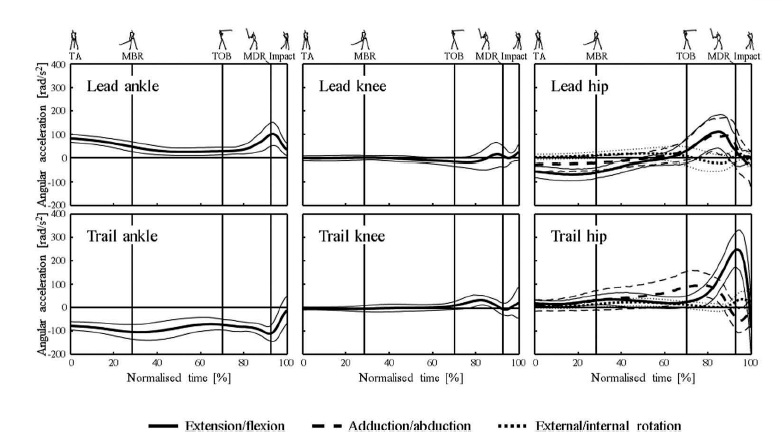
Interestingly, peak trail hip extensor torque happens on average 85% of the way through the pelvis’ downswing motion. That span runs from transition to the moment of maximum pelvis velocity. So it occurs late in the downswing. Is that another sign that golfers are trying to avoid early extension?
Study 3: hip torques in young and senior golfers
Foxworth et al. (2013) studied “Hip joint torques during the golf swing of young and senior healthy males.” By far the largest internal peak hip torque, for both young and old, was the trail hip extensor torque. All net joint torques were normalized to a percent of body weight times height (see the table below).

Overall, a typical swing involves a lot of trail hip extension torque, which is a force used to rotate a body segment. That could be a big factor in Rory’s current pain. Must golfers adopt a big forward hip flexion at address and avoid early extension until as late in the downswing as possible, when torque and speed are both high? Absolutely not.
When Low Back Spasms Need Medical Attention
This article is educational and is not a diagnosis. The National Institute of Neurological Disorders and Stroke notes that most low back pain improves over time. However, some signs call for prompt care. Seek a medical professional if you notice:
- Numbness, tingling or weakness in a leg
- Loss of bladder or bowel control
- Pain after a fall or significant injury
- Pain that is severe, worsening or not easing after several days
If your back pain shows up in your swing, a coach with swing-research credentials can help. Start with our guide to finding a coach for golf swing pain. You may also like when golf becomes G.O.L.F.
Frequently Asked Questions About Low Back Spasms in Golf
What causes low back spasms when playing golf?
Low back spasms in golf are commonly linked to repeated lumbar side bend, rotation and forward flexion at high speed. Overuse, tight muscles and a sudden awkward movement can also trigger them. A spasm is often a protective response to an irritated area.
What happened to Rory McIlroy’s back at the 2023 Tour Championship?
Rory reported a spasm in his lower back that limited his iron play. Accounts of the trigger differed. Reports mentioned a gym session, a body-weight squat and throwing his daughter into a pool. He also described chronic tightness on his right side.
Can I still play golf with low back spasms?
Some golfers manage by choosing more upright clubs and a shorter, more stable backswing, as Rory did. However, that depends on the cause and severity. Check with a medical professional first, especially if you have numbness or radiating pain.
How can I change my swing to reduce strain on my lower back?
Try minimal hip flexion at address, minimal knee flexion and pelvis rotation in the backswing, and a more upright spine. These changes reduce rotation and side bend of the lumbar spine in the downswing. They also let the big muscles fire off stable legs.
Conclusion: Managing Low Back Spasms Starts With the Swing
In short, low back spasms in golfers often come from repeated side bend, rotation and speed in the lumbar spine. Rory McIlroy’s 2023 episode shows how a protective spasm can change ball flight and posture. A stable backswing, minimal hip and knee flexion and a more upright spine can lower the strain. In addition, research suggests that how a golfer handles trail hip extension deserves a closer look. If you have red-flag symptoms, see a medical professional before changing your swing.