

Minimalist Golf Swing – by the numbers
- How the Minimalist Golf Swing helps you hit the ball Further. Straighter. Higher. Consistently.
- Is YOUR swing backed by science and research?
- The Minimalist Golf Swing – lives up to its tagline AND is the ONLY golf swing put to the test
How to acquire better ball-striking with the Minimalist Golf Swing?
For a moment, forget everything you know about the golf swing. Understand that if somehow you can get your club to arrive at the ball on an inside-out path at maximum speed, you will hit the ball further, straighter and higher; do it more consistently; and reduce the loads acting on your joints so that you are less likely to get swing-related injury. The Minimalist Golf Swing (MGS) has taken all the guesswork of generations of anecdotal, subjective teaching to give you cutting-edge science backed by continuous research.
How can I test whether I have an in-to-out path?
Find a place where you can hit real golf balls and then retrieve them – for instance, into a net. Use a sharpie marker to draw a circle around a ball. Place the ball so that the circle lies along the target line, noting which side of the ball faces upwards. Rub the sharpie across your clubface, then hit the ball before the markings can dry up. Retrieve your ball, place it back on the ground with the correct side up and the circle on the ball once again lying along the target line, and look at the markings.
Chances are the markings are more prominent on the OUTSIDE of the ball (on the side of the sharpie-circle furthest from you). This is the sign that you do not arrive at the ball from the inside. Your clubface, therefore, is smothering the best possible launch angle you could create and possibly giving you side-spin as your club moves drastically inside the target-line past impact.
This out-to-in club movement is also a sign that during the downswing your shoulders rotated before your hips, so you are unable to generate maximum club speed from your big trunk and torso muscles.
How should I arrive at the ball from the inside which will give me better direction as well as distance?
The MGS consistency is designed to not just help you deliver your club to the ball from an inside path at maximum possible speed, but to actively prevent mis-sequencing of the body parts. What that means for you the golfer is that even when you are aroused or fatigued and you are not able to repeat well-learned firing patterns, your body is positioned so as to avoid the less-desirable movements of the downswing.
So, simply trust in, and use, the Minimalist Golf Swing System which has been tested through many research projects, big and small, published and not published, at all stages of its development. The MGS movements have been researched and refined since 1993, but increasingly so over the past 6 years since I started an MS program in sports science and then PhD coursework, in all possible subjects related to human movement. Being in graduate level course-work has also offered more opportunities and equipment for research.
I have had so many lessons, watched hundreds of tips on TV, read all the magazines, nothing has worked. Why should I trust this new method?
It is never a good idea to trust blindly. Therefore, look at the recent research projects on the MGS to understand why it is a good swing for every skill level of golfer.
Electromyography (EMG) study, late 2015:
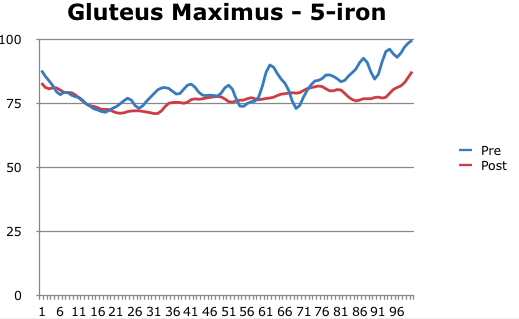
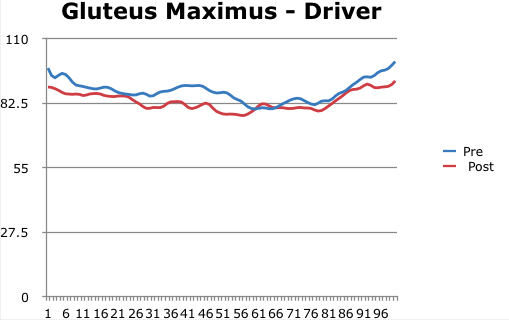
Electromyography (EMG) records the electrical activity of muscles and indicates how active a muscle is. A larger electrical signal generally means the muscle produces more force. This study tested 12 golfers (9 male, 3 female) aged 18–73 with handicaps from 7.6 to 18. Participants completed a single session where five key right-side swing muscles were measured. Each golfer hit 5 shots with their existing swing using a 5-iron and a driver, then took a brief lesson and hit about 15 practice balls with the MGS before repeating 5 shots per club. Data were analyzed using a time-normalized ensemble average across swings, participants, muscles, and clubs, producing an average of 60 swings per muscle per club. In plain terms, each swing was divided into 100 segments to allow fair comparison across different swing speeds. “Power” here indicates the study’s ability to detect meaningful differences.
A brief summary of important results:
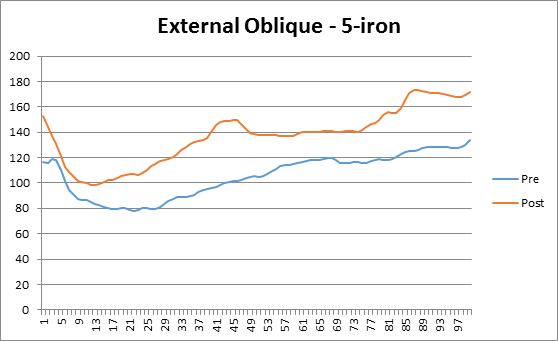
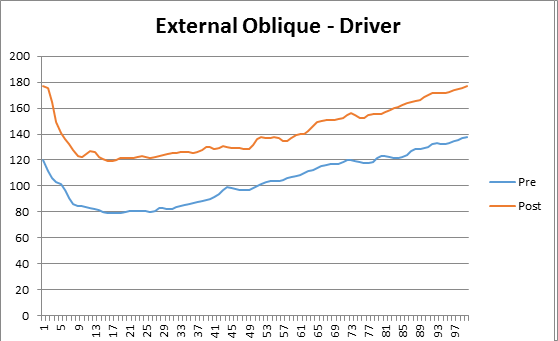
The external oblique muscle is a powerful torso rotator, and was found to be at a higher activation level throughout the back and down-swings with the MGS movement. This can be said to imply that it was stretched more during the backswing and thus contracted more forcefully during the downswing, delivering better body rotation.
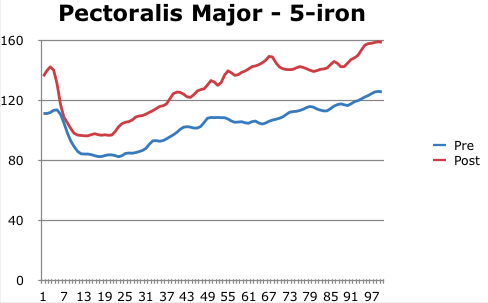
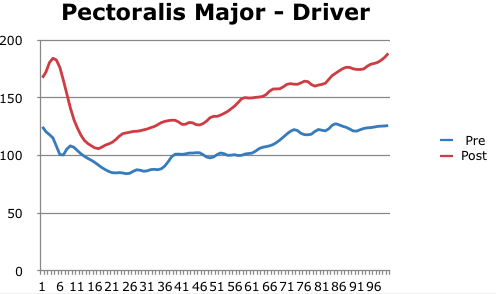
The pectoralis major is a flexor or the shoulder (moving the upper-limb in front of the body). Once again this muscle’s activity followed a similar trend as the participants’ existing swings, but at a higher level of activation throughout. It may be stated that golfers were able to use this muscle to a greater extent with the MGS, indicating greater trail arm activation, especially when it would be most useful – during late downswing.
The gluteus maximum’s main role in a “typical” swing is to forcefully straighten (extend) a bent (flexed) hip, and previous research shows that it is most forceful during the early downswing. With the MGS, as the hip joints remain fairly straight (extended) throughout the swing, so this muscle was less active at all stages of the back and through swings. The MGS does not use hip flexion at any stage, allowing the pelvis to remain level throughout, and thus permitting pure pelvic rotation for more speed during the downswing.
Two other muscles considered to be involved in the golf swing are the latissimus dorsi and the biceps femoris, but their contributions with both the participants’ existing swings and the MGS swings were different for their five irons and their drivers, so are not discussed here.
Seniors’ study 2016:
This study was open to golfers over 50, and measured their ball-flight using a launch monitor to measure ball speed, ball starting direction, and ball launch angle. The participants had their existing swings measured for two sets of 10 shots, and then received a series of 10 lessons. Ball flight was measured during sessions five and six and once again during sessions nine and ten.
One already assessed result:
Ball-flight results have not yet been analyzed. However, participants were asked to respond to a questionnaire assessing their motivation to participate in golf before, and at the end of, the study. The questionnaire is called the Sports Motivation Scale II, and assesses an overall level of motivation as well as motivation within six categories – intrinsic, integrated, identified, introjected, external and amotivation (lack of motivation).
The age range of 14 participants was 56 to 77, with an average age of 67. Their overall motivation increased from 47 to 53 and their amotivation improved from -22 to -20. Although both showed an improvement, neither was statistically significant. Intrinsic motivation, or self-motivation to participate in golf, increased significantly (p<0.05), going from 53 before to 56 after the study.
It may be said that adopting the MGS increased participants’ motivation to play golf.