
RORY McILROY – GETTING INSIDE HIS BRAIN
4th December 2025.
Rory McIlroy recently told Tiger Woods in a Taylormade video that he’s trying to be more ‘neutral’ with his driver swing. He’s attempting that by focusing on creating a straight line between his left arm and the club shaft during the backswing and using his body’s rotation to generate power, while trying to stabilize by keeping his lead (left, in his case) arm straight until well-past impact.
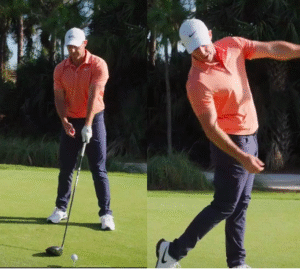
He made the change in order to reduce the dispersion of his shots. He believes his previous approach movement to the ball was more of a thrusting motion of his arms, as he demonstrated to Tiger.
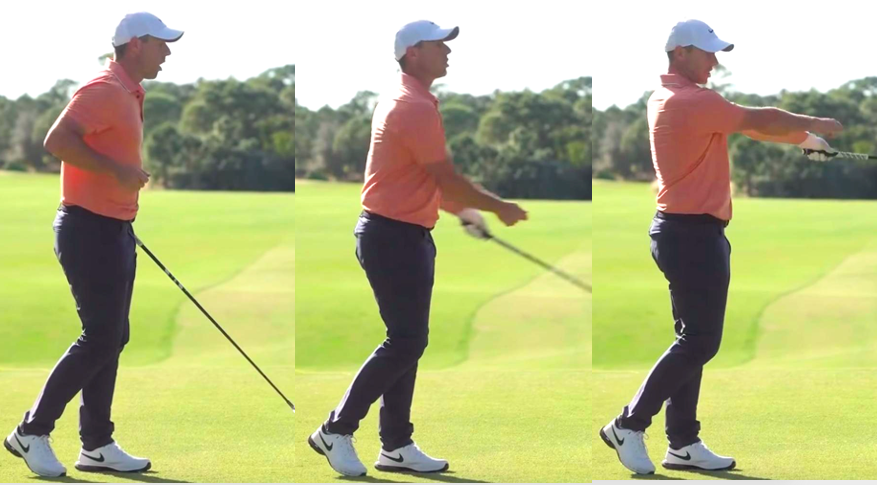
Some of Rory’s swing issues
Having been at the Driving Range of the Riviera Country Club during the week of the Genesis Invitational in February 2024 and watched Rory hit shots, it must be said that it was a glorious sight to behold. His shots were absolutely wondrous, and the way he compressed the ball made the other pros on the driving range look like kids. However, most of his shots would turn just slightly left or right, at the end.
His swing had, and still has, a lot of lateral and rotary body motion and his arms go deep in his backswing. He is also one of the rare golfers among both professionals and amateurs who makes a complicated body-reroute to manipulate his hand path to fall behind and below what it was in the backswing.
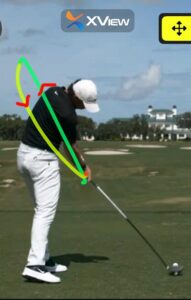
A look at Rory’s swing from the lens of how the human nervous system actually controls movement helps us to better understand whether the change to his newest swing-thought will actually help or hinder his attempts to reduce his ball dispersion.
How the Human Nervous System controls movement
The human motor control system is not, repeat not, easily able to handle interference, especially in the downswing when its tendency is to simply help rush the club to the ball – somehow and anyhow – especially given the paucity of time. How does the human nervous system actually solves the problem of getting the clubhead to the ball?
When a movement is planned, or evolves, to suit a desired end-point’s location (the ball on the ground), the nervous system has preferred solutions. They have evolved over Millenia to serve the human being’s need to reach for food and feed itself. These solutions are based on what’s mechanically and computationally easiest for the brain and body.
Think about reaching for a coffee cup on your desk. Your nervous system naturally chooses the straightest, smoothest path from your hand to the cup. This is called a “minimum jerk trajectory”—the path that minimizes sudden changes in acceleration. It’s not just efficient; it’s also the simplest solution for your central nervous system to calculate.
This same principle applies to the golf, swing but there’s one big problem: in an optimal golf swing, the clubhead shouldn’t follow a straight-line path from the top of the backswing to impact. It needs to approach the ball from an inside (the target line) path with a specific angle of attack. This is not the nervous system’s preferred solution.
The preferred ‘path of least resistance’
The human motor system, by its very nature, gravitates toward mechanically simpler patterns. In golf, this means it can more easily use gravity-assisted solutions: dropping the trail shoulder down and forward towards the ball. This is the fundamental reason why so many lower-skilled golfers come over the top (OTT). Let’s understand why less-advanced golfers are OTT:
First, gravity helps. When you drop your trail shoulder down and forward, gravity is assisting the movement. It’s literally easier because you’re getting “free” force in that direction.
Second, you’re moving less mass. The trail shoulder and arm are much lighter body parts to move than the entire pelvic and torso mass. In golf, because the feet are connected to the ground (in what’s referred to as a “closed kinetic chain”), movement at the hip joint is created by rotation of the pelvis, while the femurs (thigh bones) remain more stable. And, rotating the pelvis means moving the entire trunk and upper body with it.
Third, it requires less muscle activation. Letting the shoulder drop with gravity requires less active muscle force than resisting gravity while simultaneously generating rotational force through the hips to move a larger mass.
Fourth, it’s simpler to coordinate. A single-segment movement (shoulder drop) is much easier to coordinate than a multi-segment ground-up kinematic sequence where the golfer initiates from the pelvis, transfers energy through the trunk, and finally to the arms and club.
From a purely mechanical standpoint, the gravity-assisted shoulder drop is much easier than actively generating rotation from the ground up. This isn’t a flaw in the nervous system—it’s millions of years of evolution optimizing for direct, efficient reaching movements.
Did you know the Pros are Over-the-Top too?
While the pros may not have the overt trail shoulder down-and-forward movement often ascribed to amateurs, their hand paths are often so far forward (steep), in the downswing (see pictures below), that the trail hand and distal forearm (the part closest to the hand) might rotate ever-so-slightly at impact and create the closed face that the pros dread.
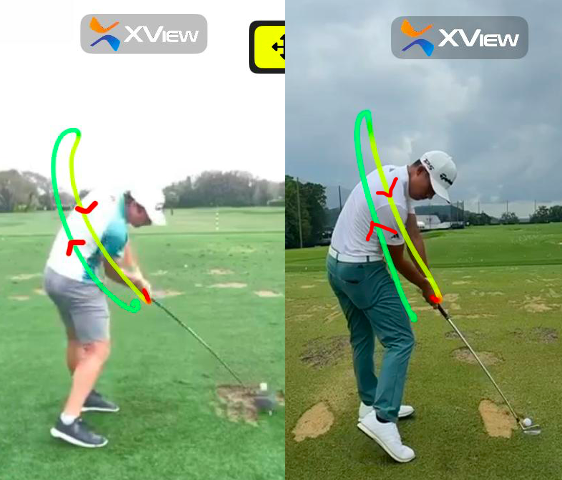
But Rory’s hands drop backwards, right? So his hand path is not steep? True, but instead, as a direct result of his hands being so far behind, there is a last-minute (last few milliseconds, actually) rush to get the hands and club to the ball, resulting in his disliked THRUSTING. His arms get pushed so far away from his body that his hands are freewheeling, and small face rotations can happen quite easily.
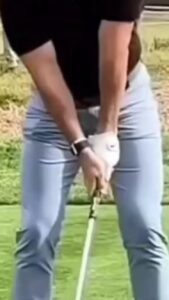
This error is compounded because, at address, Rory already has his trail forearm higher than (i.e. further from the ground), and closer-to-the-target-line than, his lead forearm. This arms-position at address, along with his entire trail arm and hand remaining higher than his lead arm from address to impact—makes it easy for that hand to occasionally roll over ever-so-slightly at impact when his timing is slightly off.
So his new solution makes sense, right?
Rory is attempting a new solution – that of keeping a straight left arm and rotating his body around it. However, the critical point is that his ‘thrust’ was a strategy that his brain had developed to compensate for a too-deep downswing hand path. His new plan is a conscious attempt to interfere with what his body had already got into the habit of doing for some years.
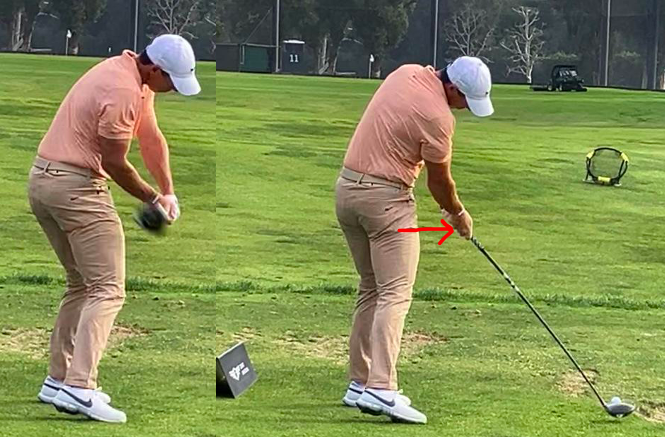
It must be said that a highly talented golfer like Rory can train himself to override the nervous system’s natural, evolved-over-centuries urge to move the hands directly towards the ball. But there are circumstances under which the default human tendency might take over Rory’s training of decades.
When does the default movement override the learned strategy?
The conditions include: the timing of his typical, complicated transition being off, as well as when he is anxious, under pressure, fatigued or distracted. Under such conditions, the carefully rehearsed new compensation patterns might start to break down.
The nervous system is remarkably good at what it does. However, under pressure and other discombobulating conditions, it will revert to its preferred solutions—the mechanically simpler, more efficient patterns that evolution has wired into human motor control systems.
If Rory wants true consistency under pressure, he needs a top of backswing position from which his hand path may move as far forward and steeply as it needs to, while still allowing the hands to arrive at the ball from a hand-path that is not so much on top of the ball! That is the only way to avoid his hands rolling over through impact, in all circumstances.
[Incidentally, the full swing of the Minimalist Golf Swing System (MGS) is designed to keep the trail hand slightly behind and lower than the lead one from address to impact, and to be in a position at the top that needs no downswing thought, compensation, or re-route. Please do check the MGS lesson packages for full swing and short game or connect to learn more.]
LETTING It Happen vs. MAKING It Happen
When you try to MAKE something happen in the downswing that lasts 1/3rd sec or less, you’re using conscious strategies. These can work on the range when you’re calm, focused, and have unlimited time to prepare. But they’re fragile. They require precise timing, perfect execution, and consistent conditions.
When you LET things happen in your downswing, because you’re in the perfect position at the top, you’ve built a swing where the physics and biomechanics naturally produce the desired result. Your nervous system isn’t fighting against its preferred solutions; it’s using them with ease. The movement is stable because it’s mechanically sound, not because you’re forcing it to work through sheer willpower and perfect timing.
Rory’s new solution is a MAKE strategy. It’s trying to fix an unviable top of backswing position with conscious control. Thus he’s basically swapping one compensation for another, without addressing the root cause of the problem.
The Prediction
Let’s wait and watch to see whether his dispersion-under-pressure persists. That is the real test – not how he hits it on the range or in casual rounds, but whether his shot pattern tightens up when it matters most.
The reason that he’s attempting a ‘rotation around a straight lead arm’ rather than the thrust he used to get, as he explained to Tiger, tells us he knows something isn’t working. But the new plan is unlikely to produce the consistency he’s seeking. Already, at the DP World Tour’s Australian Open, his first round was a collection of bogeys and birdies, leaving him at +1 and just at the cut line. From there it unnecessarily becomes a case of hoping for the best!
Even the very astute analyzer of all things golf, Sir Nick Faldo, recently said “I think it will be tough for Rory to win another one.” (i.e. another Major). Faldo was not making a swing analysis but merely stating that Rory had so much emotion on the day he make his career grand slam, it would be difficult to repeat such a feat. Rory himself has been quoted as saying, “I think I’ve always been a player that struggles to play after a big event, after I win whatever tournament,”
Those remarks are very telling because if he has low focus during his game, he might not always be able to pull off the conscious rerouting of his hands and body from the top of his backswing.
So, Rory, you need a better position at the top to allow your human nervous system to manage your downswing in the way it does best – with no interference from you, because interference is difficult to pull off consistently.